Popular
Product Showcase


Cryptocurrency Mining – How Does It Work?
How to Mine Bitcoin or Other Cryptocurrencies and How Does It All Work?
This is a common question, so below we will clearly explain how the entire Cryptocurrency Mining process works and what Bitcoin mining actually is. In short, as an introduction, Mining is a specific and cleverly designed activity where new cryptocurrency coins are controllably “produced.” And that:
- In a predetermined amount (exactly 328,500 Bitcoins are mined annually)
- Regardless of whether the cryptocurrency is mined by one or 10 million miners worldwide.
The mining process works using computing power (powerful computers – miners). Today, there are already 5 different ways to obtain mining power and thus how to mine Bitcoin as well as cryptocurrencies like Ethereum, Zcash, or Monero.
We have been covering all these 5 methods (sales / production / service / rental) since 2015.
- GPU Mining Rigs from graphics cards for mining hundreds of different cryptocurrencies
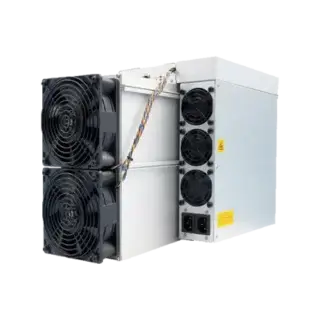
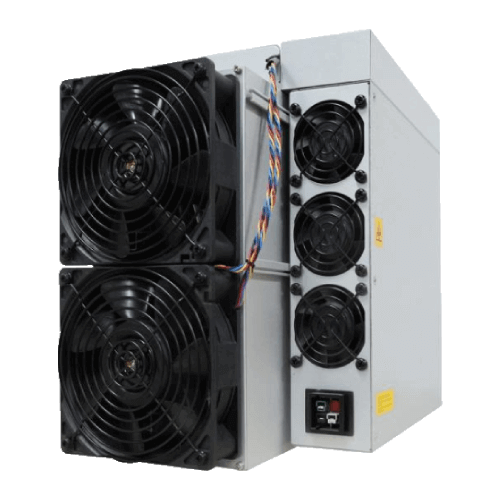
- ASIC Miners, with which you can mine a smaller number of coins, but with much higher efficiency
- New ECO HDD Miners
- Mining Power Rental (Cloud Mining)
- Housing (your miner stored in our data centers, for cheap electricity)
The most profitable are ASIC and GPU miners. But which one is the most worthwhile?
Here are 8 Main Differences between ASIC and GPU miners
So What is Mining? What Do All Those Miners Do?
Miners Verify Transactions = Cryptocurrency Mining
If you send money to a friend through a bank, the bank verifies the payment, checks if you have a sufficient balance, and records it (debits your account and credits your friend's).
Bitcoin, however, has no owner or director (center). Cryptocurrencies are decentralized, so payment verification is not done by 1 center like in a bank, but by Hundreds of Centers (computers) Worldwide = mining.
And as a reward for that, they receive fees (which you pay when sending BTC to someone) and also newly created cryptocurrency coins. In other words: they mine cryptocurrency.
And thanks to the fact that cryptocurrencies are not controlled by any “director,” your BTC payment cannot be rejected (as a risky transaction), as happens in banks (if, for example, you send money abroad or large amounts, the bank simply Cancels and Does Not Send your payment, or may report it to the financial authority...).
What About Mining Profits? How Much Will I Earn?
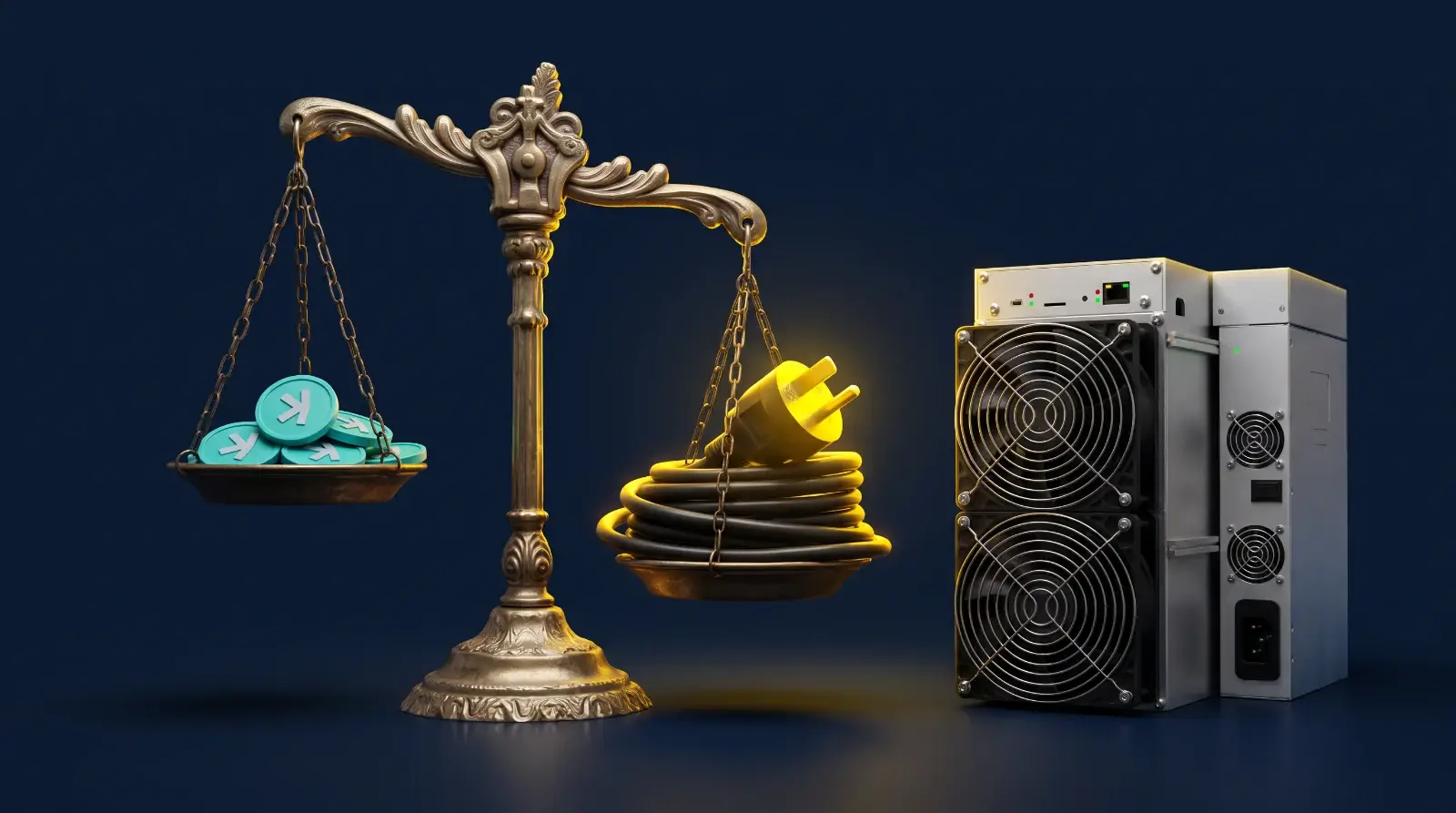
Okay, okay... that's theory. But I'm interested in mining profits. How much will I earn and Is It Still Worth Mining Cryptocurrencies? Mining is definitely worth it because you literally get cryptocurrencies at a discount. The only question is the exact amount of profits. So how to find out? Simply by comparing:
- Mining costs (miner price and electricity consumption)
- Yields (how many coins you mine)
Calculations of exactly how much each miner earns now (including electricity costs) can be found below.
How Much Does Mining Earn?
PS: Data Center: If you can't have a miner at home, you can use Housing in a Data Center.
Is Mining Still Worth It? [e-book]
- 8 Reasons NOT to Invest a Cent in Mining!
- + 8 Reasons Why It's Really Worth It.
8 Reasons NOT to Invest a CENT in Mining
(Also) Harsh Conclusions from 4 Years of Our Investing.
Cryptocurrency Mining as a Cipher
Cryptocurrency Mining - How Bitcoin and Other Cryptocurrencies Mining Works. You can imagine mining as a cipher that you have to decipher. The more powerful your miner (powerful computer) is, the faster it decodes the cipher and the faster you get the reward in the form of mined coins.
This entire principle is also described in the so-called White Paper of each cryptocurrency, which is perhaps the most important document of each digital currency.
Below, you'll find a detailed explanation of important terms directly related to mining.
- Blockchain technology, Transaction Block
- Hashrate, Mining Difficulty
- Mining pool, Algorithm
Up to the chronological process of How Cryptocurrency is Mined and how the entire mining process works in individual steps. The process that takes place on every mining rig for cryptocurrency mining.

MINING Terms
#1 Blockchain (Chain of Blocks)
Blockchain - Cryptocurrency Technology and Public Ledger
Blockchain is the technology on which every cryptocurrency in the world is built. It ensures accuracy, infallibility, 100% security, and the unforgeability of cryptocurrencies. All thanks to “control” or verification of transactions performed by all other network users, specifically millions of cryptocurrency miners (PCs) worldwide (unlike banks, where this entire process is performed by 1 central system).
Blockchain is also a public ledger in which all completed transactions in the Bitcoin network or other cryptocurrency are recorded. In this Blockchain “book,” you can actually see even the very first transaction performed by Bitcoin (from 2009).

Broken down, this entire transaction database is divided into smaller chains of blocks (literally).
And it is in these blocks that all transactions performed in a specific cryptocurrency worldwide are stored (recorded).
After a new block is created (every 10 minutes), this block is chronologically added after the last (previous) mined block, thereby creating a chain (set of blocks), i.e., Blockchain. More about blockchain technology and its uses (Forbes article).
#2 Block
One Bitcoin block is therefore a set that contains information about all transactions completed in approximately the last 10 minutes.
Why over a period of ten minutes? You'll find out below. All transactions in each block are verified by miners before being recorded in that block. Miners then receive a reward for this work (their computers' work), specifically one new block of BTC coins.
An important parameter is the average time required to mine 1 cryptocurrency block.
In the case of the mother of cryptocurrencies, each BTC block is mined approximately every 10 minutes (600 seconds). This value represents 144 blocks per day. And after recalculation, it exactly corresponds to the mining of the last Bitcoin in the world approximately in the year 2141.

For the cryptocurrency Bitcoin, the algorithm sets the block size at 50 BTC, with the block halving rule (so-called Bitcoin Halving) applying.
As you can see in the table above, after every 210,000 mined blocks, the mining reward is halved.
In the case of BTC, the size decreased from 50 to 25 BTC coins in 2012. After mining another 210,000 blocks (2016) of size 25 BTC, the size of 1 block halved again. Thus from 25 to 12.5 BTC coins every 10 minutes. In 2020, it halved again. From 12.5 to 6.25 BTC coins and so on.
As you can see, mining 210 thousand Bitcoin blocks represents a period of approximately 4 years. The fact is therefore that:
Half of all Bitcoins were mined in the first 4 years of Bitcoin's existence (2009-2013).
Mining the second half of BTC coins will take approximately another 128 years (2013-2141). This also means that in 2020, 89% of all Bitcoins are already mined. The remaining 11% will be mined over the next approx. 121 years. And this means that from now on, only crumbs will enter circulation (be mined) each year... Most Bitcoins are mined. They are limited. And scarcity is a strong psychological factor that causes the price of Bitcoin... Yes, yes. It should rise.

On the official Blockchain pages, you'll find an overview of all mined blocks with the exact order number of each block, exact mining time, number of contained transactions, or current mining reward (block reward), which is currently 6.25 BTC (2020-2024).
“How is it possible that 1 Bitcoin block is always mined in 10 minutes, when the number of miners is constantly increasing?”
The answer is Simple.
To prevent the premature mining of Bitcoins, it is necessary to regulate mining – i.e., make mining more difficult. Simply, it is necessary to ensure that even with an extreme increase in the number of miners, the year of mining the last Bitcoin remains 2141 and the average time to mine a block is preserved.
That is why every cryptocurrency's algorithms include an automatically changing parameter, which is mining difficulty. To understand difficulty, we need to know more about power.
#3 Hashrate (Mining Network Power)
Hashrate is an indicator that shows the power (strength) that a machine achieves for mining cryptocurrency.
The basic unit of mining power is Hash per second (H/s). The total Hashrate is therefore the sum of the power of all mining machines for a specific cryptocurrency (worldwide).
The total hashrate (network mining power) grows for 2 reasons:
- Continuously improving technologies in the production of mining components
- Popularization of cryptocurrencies and thus an increasing number of miners
The increase in total network power should theoretically indicate a shorter time to mine one block.
But since the average time to mine 1 block is firmly set at 10 minutes (600 seconds), the above-mentioned difficulty indicator comes into play.
#4 Difficulty (Mining Difficulty)
The mining difficulty of any cryptocurrency is an automatically changing parameter, for which the rule applies:
The growth of total mining network power (growth in the number of miners) causes an automatic increase in mining difficulty.
Difficulty is one of the most important factors in cryptocurrency mining, on which the resulting yield and profitability depend. Difficulty also ensures that the average time to mine one Bitcoin block remains 10 minutes, and thus the year of mining the last Bitcoin coin is exactly in 2141.
“When does the total mining network power grow?”
Power grows when the number of mining devices increases and thus when mining becomes profitable. If the number of miners of a specific currency grew, the average time to mine a block would constantly decrease.
Thanks to the automatic increase in mining difficulty, the average time stays at the same level.
Difficulty is an automatically changing but time-delayed indicator. After an increase in network hashrate, the mining difficulty increases or decreases only after approximately 14 days.

Blue curve – Bitcoin Network Hashrate. Red curve – Bitcoin Cryptocurrency Mining Difficulty. (graph borrowed from the Bitcoinwisdom page)
How are Bitcoin and Other Cryptocurrencies Mined? [Process]
How Bitcoin and Other Cryptocurrencies Are Mined
Mining involves 2 chronologically arranged steps:
- Verification of transactions from the previous block.
- Simultaneously generating new coins for the new (next) block as a reward for the miner.
Cryptocurrencies are mined using powerful hardware and specialized software, which together perform thousands of mathematical calculations.
Mining – Verifying Transactions
Cryptocurrency mining is nothing other than comparing and checking the correctness of transactions in the last block. Just as every payment in a bank goes through verification, cryptocurrency payments are also verified to prevent network errors, such as...
- Duplicate transaction (one transaction sent accidentally twice)
- Or the infeasibility of the transaction due to a low balance (you send someone Bitcoin even though you don't own any).
Thanks to miners, such errors never occur in cryptocurrencies.
As a reward for verifying crypto transactions, miners receive mined blocks (i.e., new cryptocurrency coins).

Why Are Miners So Necessary for Cryptocurrencies?
- Thanks to miners, new cryptocurrency coins enter circulation.
- Thanks to miners, the entire cryptocurrency network is 100% verified and secure. Infallibility and accuracy are guaranteed. There is no way to bypass the blockchain and transaction verification, as can happen in the banking sector.
This is exactly the point of cryptocurrencies: to provide fast transactions without waiting for bank approval as a central institution.
In the crypto world, transactions are verified by the network users themselves (miners). Thanks to this, transactions are multiple times faster and with significantly lower or even zero fees.
Finally, an explanation of the quantity in which cryptocurrencies are mined.
Cryptocurrencies are mined in so-called blocks. A miner can therefore mine one entire block or none (no quarters or smaller parts). However, to mine one entire block (6.25 BTC, currently worth approx. €100,000), you need an enormous amount of computing power worth tens of thousands of euros at today's mining difficulty.
Mining Pool
If you decided to mine alone with low power, mining 1 BTC block would take much longer. However, miners came up with a simple solution in the form of a Mining POOL. By the way, the “invention” of the very first Bitcoin mining pool comes from our brothers in Czechia.

Mining POOL
A mining pool connects a large number of miners into one whole, who contribute their power to mining, thereby creating huge clusters of mining power.
With a much greater computing power from a large number of miners, the probability of mining one entire Bitcoin block increases rapidly, unlike autonomous solo mining.
The principle of equivalence applies to mining in a mining pool:
The more power a miner contributes to the pool, the larger share of the mined Bitcoin block they get.
Mining Algorithm
As we already mentioned, mining takes place using specialized hardware and software. The algorithm is the program (software) through which mining takes place.
It is a program that can perform mathematical operations and thus mine cryptocurrency. There are approximately 60 mining algorithms, but each can only mine a certain type of digital currency.
Which Cryptocurrencies Can Your Miner Mine?
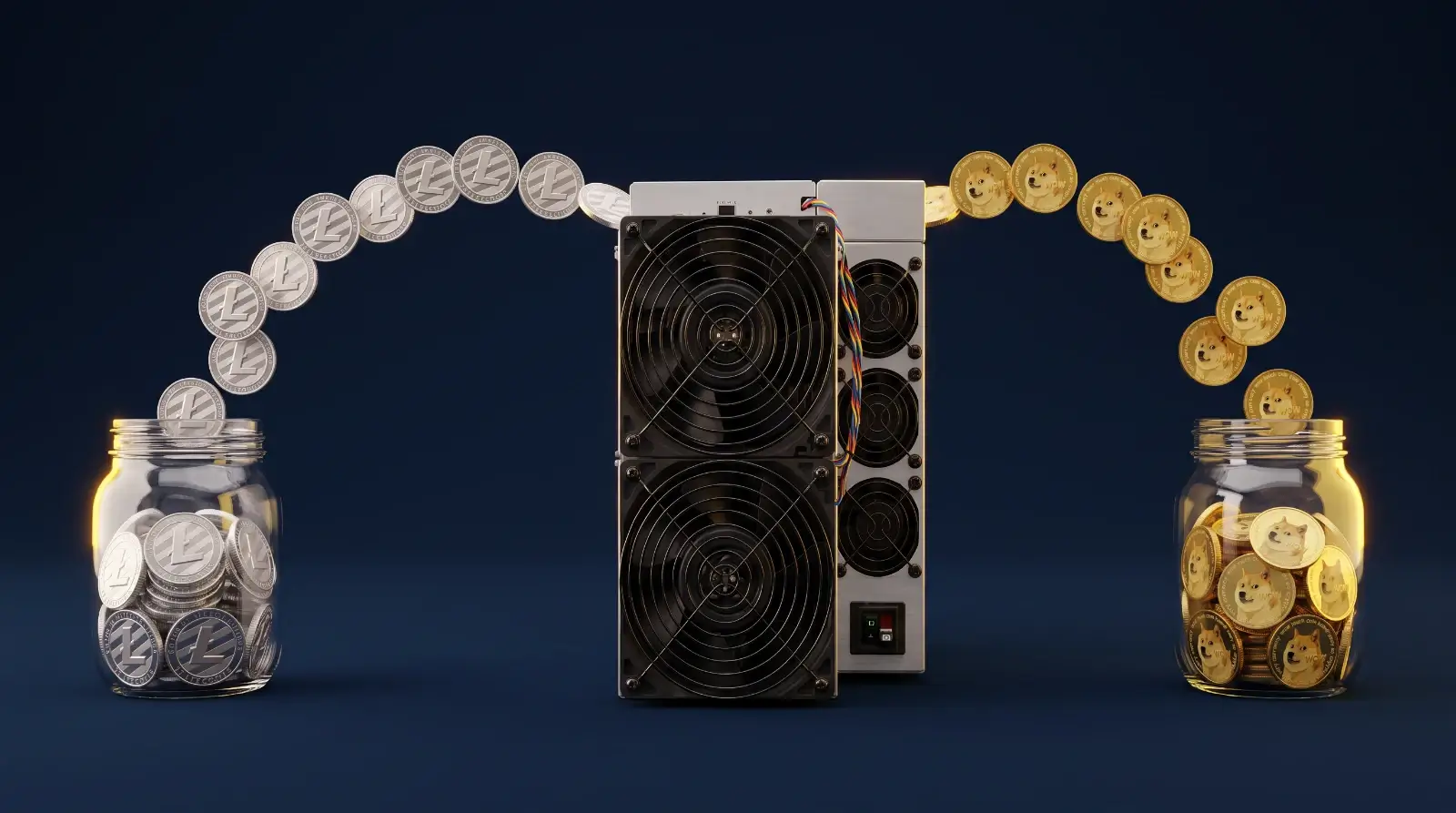
- Each ASIC miner is made for 1 algorithm.
- Each such algorithm “contains” approx. 10 to 100 different cryptocurrencies.
In other words: With each ASIC miner, you can mine every single coin that the given algorithm contains (see list below).
Example:
Antminer S19 110 TH/s is a miner for the SHA-256 algorithm. The SHA-256 algorithm includes up to 191 cryptocurrencies. With this Antminer S19, you can therefore mine any of these 191 cryptocurrencies.
You can switch mining to another coin manually in the miner's application (a 30-second task), or you can set up a program (pool) like Nicehash, which switches mining (automatically) to the most profitable coin that can be mined with your miner.
Notes:
- You often hear the phrase “BTC miner” or “ETH miner.” But that doesn't mean it's a miner that mines only Bitcoin and nothing else. People just call it that. A BTC miner means a miner for the SHA-256 algorithm, which mines Bitcoin as the main cryptocurrency but also another 191 cryptocurrencies that you can switch to. "BTC miner" is just a name because the main cryptocurrency of those 191 coins is Bitcoin. The same goes for “ETH miners,” “Zcash miners,” etc.
- Dual-Mining – dual mining is possible on miners, i.e., mining 2 cryptocurrencies at once. However, this type of mining makes little sense because when mining 2 cryptocurrencies, one of them is always more profitable than the other (half of the machine's power goes to one cryptocurrency, and half to the second). So at first glance, it seems that you earn more when mining 2 coins at once, but the exact opposite is true. You earn slightly less.
- Since Bitcoin is mined on the SHA-256 algorithm, Ethereum on the Ethash alg., Litecoin on the Scrypt alg., and Zcash on the Equihash alg., it means you can't mine ETH, Litecoin, or Zcash on “BTC miners.” They work on different algorithms (and thus require a different miner). Similarly, you can't mine BTC, LTC, Zcash, etc., on ETH miners. These main (largest/most popular cryptocurrencies) work on separate (different) algorithms.
Below you will find a list of cryptocurrencies that individual miners can mine.
SHA-256 (Bitcoin ..)
- Bitcoin
- Bitcoin Cash
- Factom
- OTOCASH
- EDC Blockchain
- Namecoin
- Libra Credit
- Peercoin
- Litecoin Cash
- Steem
- PCHAIN
- Emercoin
- VeriBlock
- Counterparty
- Crown
Ethash (Ethereum ..)
- Ethereum
- Ethereum Classic
- Energi
- Metaverse
- Restart Energy
- Ether Zero
- Ubiq
- Callisto
- Pirl
- Musicoin
- Expanse
Scrypt (Litecoin ... )
- Litecoin
- Dogecoin
- MonaCoin
- YOU COIN
- ReddCoin
- CyberMiles
- Syscoin
- ECC
- Einsteinium
- Matrix AL Network
- Karmacoin
- Linda
- Flo
- Viacoin
- Hi Mutual Society
- Gulden
Equihash (Zcash .. )
- Zcash
- Horizen
- Bitcoin Gold
- Bitcoin Private
- BitcoinZ
- Komodo
- Beam
- ZenCash
- Aion
- Ycash
- ZelCash
- Zclassic
X11 (Dash ..)
- Dash
- Pura
- Enigma
- Bollberry
- E-Dinar Coin
- StakeNet
- Mmetic
- Xcurrency
- Paccoin
- Polis
- MonetaryUnit
- I/O Coin
- Pura
- BitSend
Cuckatoo31+, Cuckatoo32+ (Grin ..)
- Cuckatoo31+
- MimbleWimbleCoin (MWC31)
- Cuckatoo32+
- Grin (GRIN)
Hard Disk - HDD Mining (Proof of Capacity Protocol)
Cryptocurrencies you can mine on the PoC protocol (i.e., not on ASIC or GPU miners, but on HDD miners)
(difference between mining on ASIC / GPU rigs and mining on HDD miners HERE – PoW vs PoC algorithms)
- Bitcoin HD
- Burst
- Chia
- HDDcoin
- Storj
- Filecoin
- XRP HD
- Litecoin HD
- Boom
- Diskcoin
- Signa
- HDD Cash
- Mass
- Arweave
- Flax
- Chives
- HDDcoin
- SpaceMint
Got Questions?

Contact Us
Didn't find the info you need?
Want Expert Advice?
Contract Preview?
How does it all Work?
Contact us and one of our experts will assist you:
- +421949691788 / +420704736656
- support@miner-house.com
Our experts will advise you
Write to us and one of our experts will get back to you as soon as possible.
Our prices are the lowest in the entire EU!
If you found a lower price somewhere, send us the link and we'll contact you with our better offer right away.