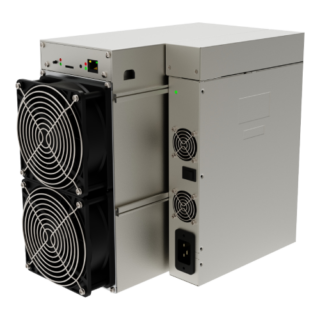
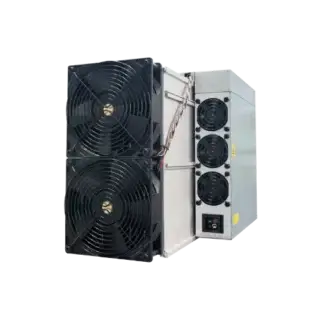
Category
Popular
-
test fan
Price on Request
-
Avalon Nano 3 (4 TH/s)
310€
-
NerdMiner NerdOCTAxe Rev 3.1 (12 TH/s)
480€
-
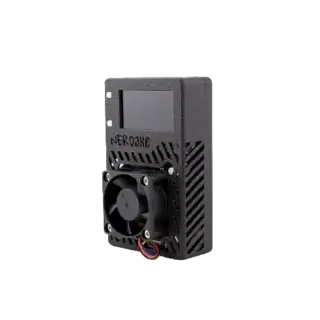
NerdMiner Nerdaxe Ultra (0,5 TH/s)
125€
-
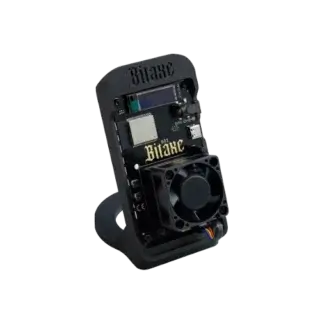
Bitaxe Gamma 601 (1,2 TH/s)
199€
Product Showcase
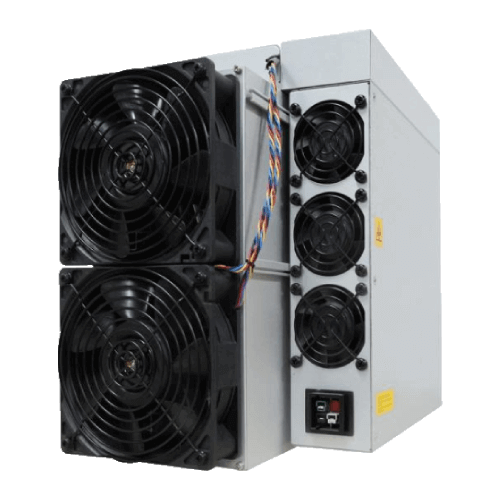
Antminer L9 Review: Why a 128-Month Payback Can Be a Buy Signal
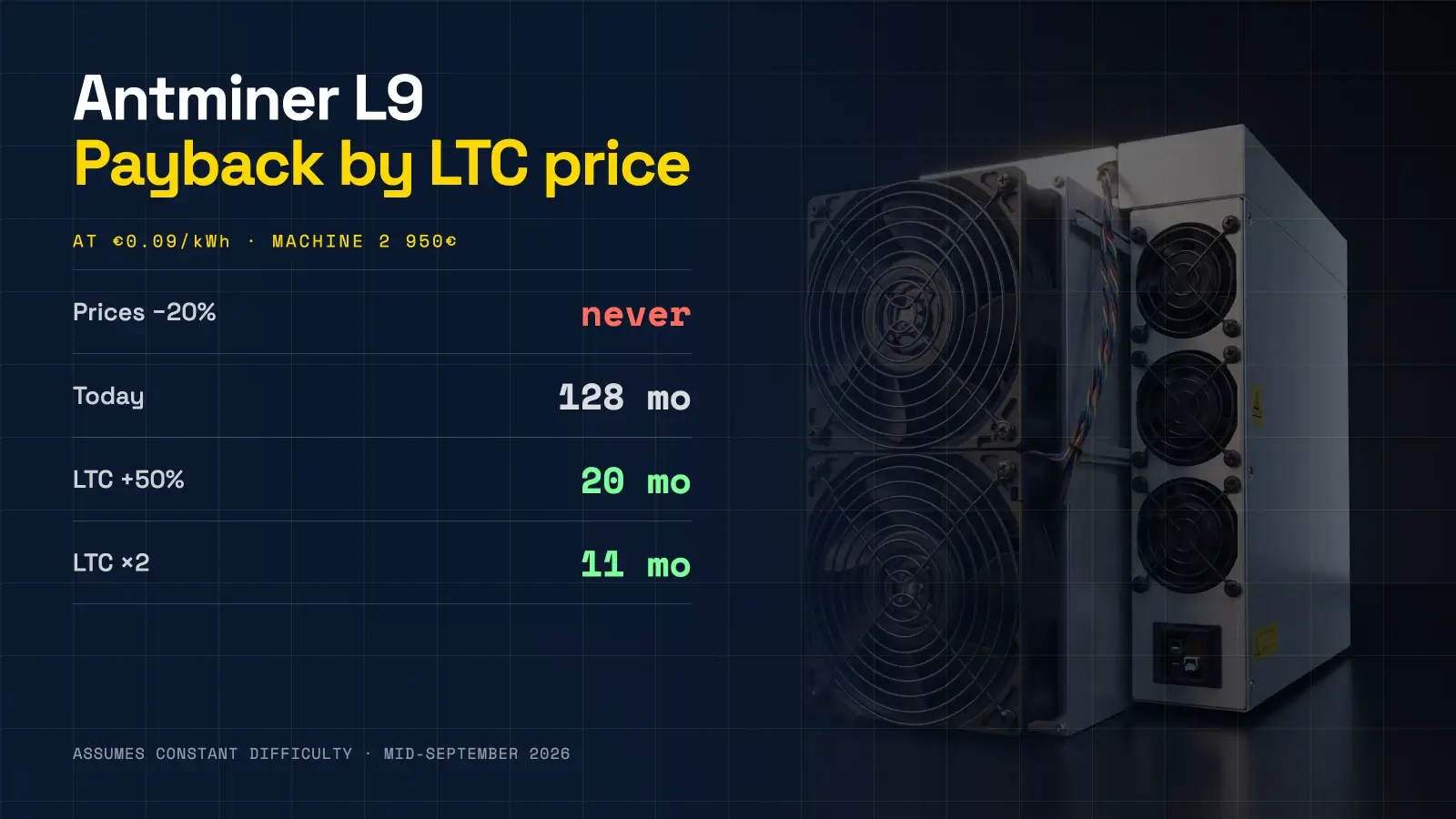
At today's prices the Antminer L9 looks like a terrible purchase. Running at €0.09/kWh it mines about 244€ of Litecoin and Dogecoin a month, spends 221€ on electricity, and keeps 23€ — a payback of roughly 128 months. Most reviews stop there and tell you to walk away. We think that reading is incomplete, and the reason is arithmetic rather than optimism: if LTC simply returns to 100€, the same machine keeps 267€ a month and pays back in about 11 months. Double the coin price, and profit rises more than elevenfold. This review explains why that happens, what it means for when to buy, and — just as honestly — the conditions under which the same maths works against you.
The Antminer L9 at a glance
| Spec | Antminer L9 |
|---|---|
| Hashrate | 16 GH/s (Scrypt) |
| Power | 3,360 W |
| Efficiency | 0.21 J/MH |
| Coins | Litecoin + Dogecoin merged, plus smaller Scrypt coins on some pools |
| Noise / cooling | ~75 dB, air-cooled |
| Our price | 2 950€ (around 16 300€ in January 2025) |
Merged mining is what makes Scrypt different: one machine's hashrate secures Litecoin and Dogecoin simultaneously, earning both coins for the same electricity. Dogecoin also pays a fixed 10,000 DOGE per block with no halving schedule, so that half of the income doesn't shrink on a timetable. Our mining pool guide covers which Scrypt pools handle merged payouts best.
Why thin margins create enormous leverage
Here's the mechanism most payback calculators hide. Your electricity bill doesn't care what LTC costs — it stays at roughly 221€ a month either way. Your revenue, meanwhile, moves one-for-one with the coin price. So when revenue sits only slightly above the power bill, almost all of any price increase drops straight into profit.
| At €0.09/kWh | Today (LTC ≈ 50€) | LTC doubled (≈ 100€) |
|---|---|---|
| Mined per month | 244€ | 488€ |
| Electricity | −221€ | −221€ |
| Net profit | +23€ | +267€ |
| Payback on 2 950€ | ~128 months | ~11 months |
| Annual return | ~9% | ~109% |
The practical consequence is counterintuitive. When coin prices are low, displayed payback periods are badly distorted — they extrapolate the worst moment of the cycle forever. A 128-month figure doesn't describe the machine; it describes today's LTC price.
We've just watched this happen with Zcash
This isn't a hypothetical. In early August, Zcash traded near $486 and a Z15 netted about €10 a day at a hosted rate. By early September ZEC had reached roughly $1,190, and the same machine was netting around €26 a day — with its Pro sibling becoming the most profitable ASIC on the market and selling out at Bitmain. The hardware didn't change. The coin price did, and the leverage did the rest. Our Z15 Pro review documents the numbers.
The scenarios, including the uncomfortable ones
A doubled price is one outcome among several, so here's the full range at €0.09/kWh on a 2 950€ machine:
| LTC/DOGE price scenario | Net per month | Payback |
|---|---|---|
| Prices fall 20% | ≈ −26€ | Never — switch off |
| Today's prices | ≈ +23€ | ~128 months |
| Prices +50% | ≈ +145€ | ~20 months |
| Prices 2x, difficulty +25% | ≈ +169€ | ~17 months |
| Prices 2x, difficulty unchanged | ≈ +267€ | ~11 months |
| Prices 3x, difficulty unchanged | ≈ +511€ | ~6 months |
Two rows deserve attention. First, the difficulty-adjusted line: rising prices pull older machines like the L7 back online, which raises difficulty and trims every miner's share — the Zcash network showed exactly that, with revenue per MWh slipping even as the coin climbed. A doubling of price therefore rarely means a doubling of revenue. Second, the top row: leverage works in both directions. A 20% drop pushes the L9 below break-even, and at that point the right move is to switch it off rather than mine at a loss. Check live figures on the CoinWarz Scrypt calculator before deciding.
The condition that makes or breaks the thesis: electricity
Everything above assumes €0.09/kWh. At a typical European household rate of €0.25, the same L9 burns around 613€ of electricity a month. Double the coin price and it still loses roughly 125€ monthly; only a tripling gets it back into profit. In other words, the buy-at-the-bottom strategy only works with cheap power. At home it's a bet you can't afford to hold; in a hosting datacentre it's a position you can wait out. Our European electricity breakdown shows where your country lands.
Machine prices follow the same cycle
There's a second lever beyond mining income. When profits collapse, hardware prices collapse with them — the L9 cost around 16 300€ in January 2025 and costs 2 950€ today, a drop of over 80%. When mining profits recover, demand for machines returns and prices typically follow. Buying during the trough therefore means paying the lowest price for the hashrate at precisely the moment its future earnings look worst on paper.
The honest caveat: resale value won't necessarily climb back to launch levels, because newer hardware keeps arriving. The Antminer L11 already delivers 20 GH/s at 0.184 J/MH, and hydro Scrypt machines go higher still. Treat any hardware appreciation as a bonus, not the plan.
L9 or L11?
If you're weighing the newer machine, the choice comes down to which kind of leverage you want:
- Antminer L9 (2 950€) — cheaper leverage. Lower entry cost and the stronger percentage gain if prices recover, but it slips into loss first when prices fall.
- Antminer L11 (4 485€) — safer leverage. At 0.184 J/MH it clears roughly 60€ a month at today's prices and stays around break-even through a 20% decline, but you pay about 50% more upfront.
Who should buy an Antminer L9 now
- You have electricity at or below roughly €0.09/kWh, or you'll host the machine.
- You believe LTC and DOGE are closer to a cyclical low than a high, and you can hold for 12–24 months.
- You want to accumulate Litecoin and Dogecoin below market cost rather than buy them on an exchange.
- You accept that the machine may earn almost nothing — or be switched off — until prices recover.
Who shouldn't
- Anyone mining at a household tariff above roughly €0.15/kWh.
- Anyone who needs monthly income now. At today's prices the L9 is a position, not a paycheque.
- Anyone who couldn't tolerate the coins staying low for a year or more.
FAQ: Antminer L9
Is the Antminer L9 profitable in 2026?
Why does profit rise so much when the coin price doubles?
What happens if LTC and DOGE prices fall further?
Can I run an Antminer L9 profitably at home?
Antminer L9 or L11 — which should I buy?
Why has the Antminer L9 price dropped so much?
Buy the hashrate while it's cheap — run it where power is cheap
We've sold miners across Europe since 2015, and we'd rather show you the downside scenarios than just the upside ones. See the Antminer L9 and L11 in our shop, run them at industrial rates in our hosting datacentre, and send us your €/kWh — we'll calculate your scenarios, including the ones where you should wait.
Disclaimer: We are not financial advisors. Figures are a snapshot for mid-September 2026 based on our own profitability calculation; LTC and DOGE prices, network difficulty and mining revenue change continuously. Price scenarios are illustrations, not forecasts — coin prices may stay low or fall further, and past recoveries do not guarantee future ones. Never invest money you cannot afford to lose.
Written by Denis
Best offers
Join Risk Free
30 days refund
100% Safe
Secure Shopping
24x7 Support
Online 24 hours
Best Offers
Grab Now
Free Shipping
On all order over
Know Us
- Top SK-CZ vendor since 2015, now expanding across EU
- Buy directly from our EU wholesalers
- 29 wholesalers = always lowest ASIC prices
- Up to 2-year warranty on Bitmain miners
- Personal support: miner choice, profit calculation
- Free miner setup
Store Updates