Popular
Product Showcase


Antminer Z15 Pro Review: Which of the Three Variants Should You Buy?
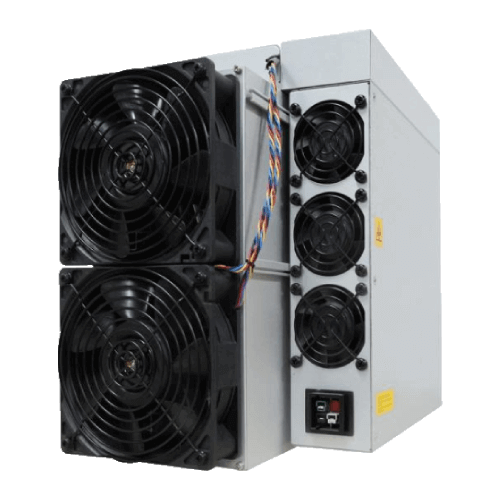
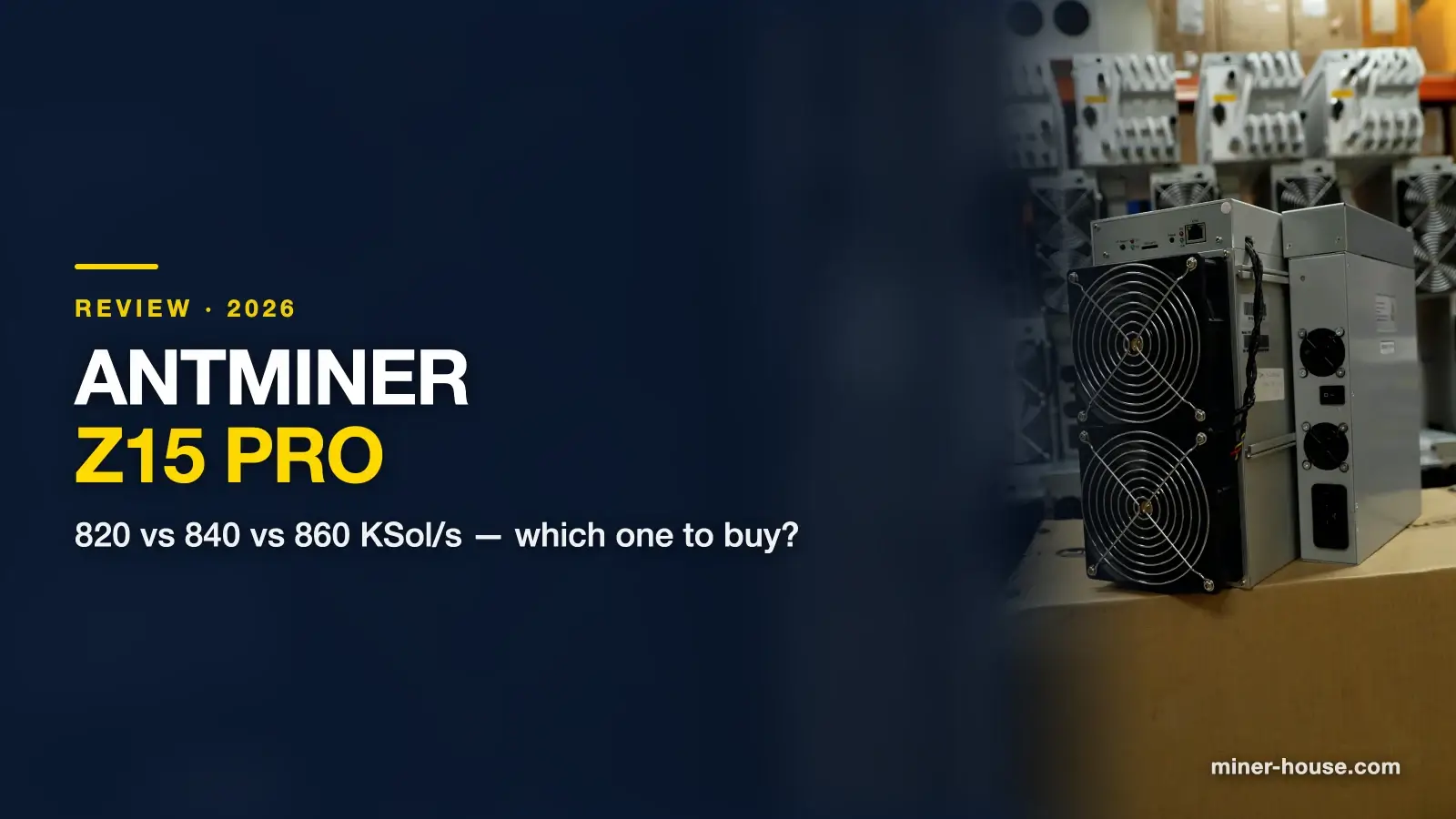
The Antminer Z15 Pro is currently the most profitable ASIC miner on the market, earning roughly $59 a day while Zcash trades near $1,190 — a coin that has gained about 98% in thirty days and now sits ninth by market cap. Bitmain has sold out of it. What almost nobody explains, though, is that the Z15 Pro isn't one machine: it ships in three bins of 820, 840 and 860 KSol/s, separated by just €380. Those bins are not priced proportionally, and after running the numbers we'd steer most buyers away from the middle one — even though we stock it. Here's the full comparison, the real payback maths, and an honest look at how long this window stays open.
The three variants, side by side
All three bins run the Equihash algorithm at essentially identical efficiency, near 3.3 joules per KSol. What separates them is hashrate, power draw and — decisively — price per unit of hashrate:
| Variant | Price | Power | € per KSol/s | Verdict |
|---|---|---|---|---|
| Z15 Pro 820 KSol/s | 3 560€ | 2,720 W | 4.34€ | Best value per hash |
| Z15 Pro 840 KSol/s | 3 870€ | 2,780 W | 4.61€ | Worst value of the three |
| Z15 Pro 860 KSol/s | 3 940€ | 2,838 W | 4.58€ | Most hashrate per rack slot |
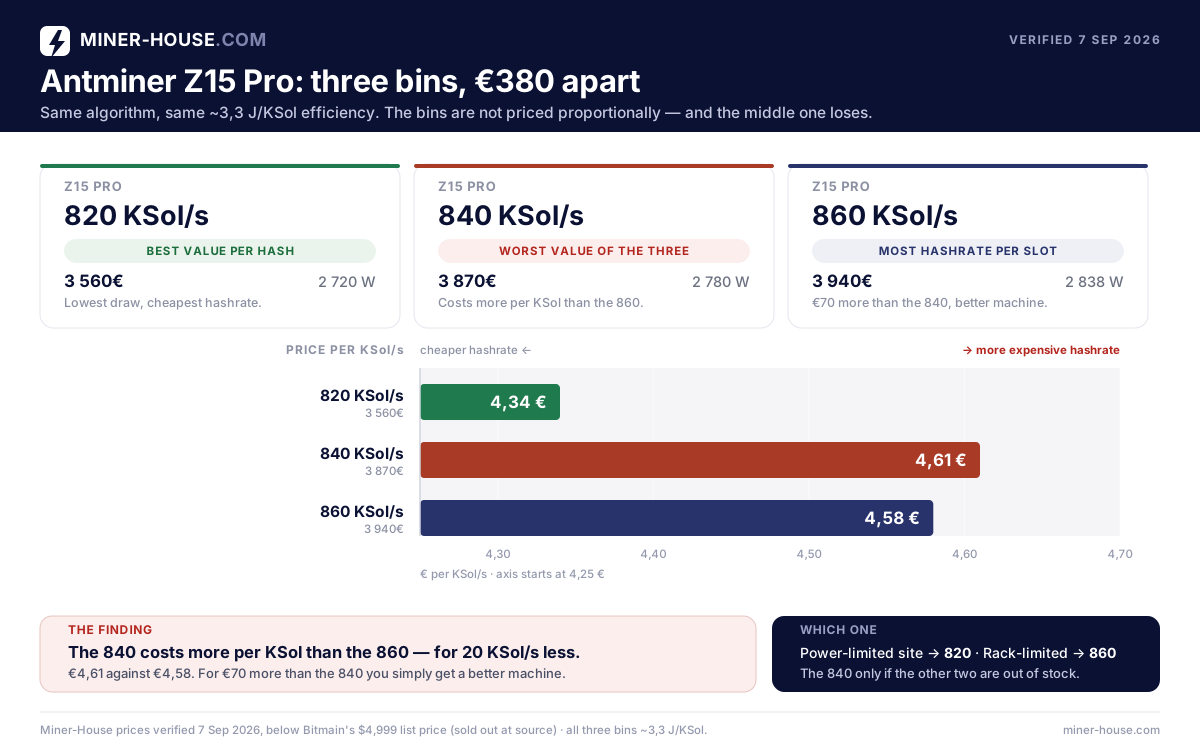
Read the fourth column again, because it's the finding that matters. The 840 bin costs more per KSol than the 860 bin does — €4.61 against €4.58 — while delivering 20 KSol/s less. It sits in the middle of the range and represents the worst of both ends. For €70 more than the 840 you simply get a better machine. And if you want the cheapest hashrate available, the 820 wins outright at €4.34 per KSol while also drawing the least power.
What it actually earns
At current Zcash prices a Z15 Pro grosses roughly $60 per day. Here's what remains after electricity, at three realistic European rates:
| Electricity rate | Daily power cost | Net per day | Net per month |
|---|---|---|---|
| €0.08/kWh (hosted) | €5.3 | ≈ €50 | ≈ €1,500 |
| €0.18/kWh (good EU contract) | €12.0 | ≈ €43 | ≈ €1,290 |
| €0.25/kWh (typical household) | €16.7 | ≈ €38 | ≈ €1,140 |
This is the point we've made across every guide on this site: Zcash machines break even near €0.36–0.38/kWh, which is why a Z15 Pro earns money at an ordinary household socket while Bitcoin machines lose money there. Our European electricity cost breakdown shows exactly where your country lands.
Payback — and why we're telling you to halve it
Divide the purchase price by daily net profit and the numbers look almost implausible: the 840 bin at 3,870€ pays for itself in roughly 77 days on hosted power, or about 102 days at a €0.25 household tariff. Under four months on a machine rated for four to six years of service.
Now the honest part. Those are rally numbers, not planning numbers. They exist because ZEC rose from $486 in early August to nearly $1,200 today, and nothing about that pace is normal. Model your purchase at half of current revenue instead — which puts payback nearer six to eight months. If the decision still holds at that level, it's a sound one. If it only works at today's figures, you're betting on the Zcash price rather than investing in hardware, and those are different things.
The window is already narrowing — here's the evidence
We can be specific rather than vague about this. Zcash network hashrate has pushed above 30 GSol/s, near record levels, as machines pour in to chase these margins. The consequence is already measurable: a Z15 Pro generated $708 of gross revenue per MWh on 4 September, down from $727.30 on 24 August — roughly 3% less, despite ZEC being considerably more expensive over that same period.
That is difficulty doing exactly what difficulty does. More hashrate arrives, each machine's share shrinks, and revenue per unit falls even as the coin climbs. The rally is currently outrunning the difficulty increase, but the gap is closing, and the hardware ordered during this rally hasn't finished shipping yet. Verify the current position yourself on WhatToMine on the day you decide.
Availability: why the price matters right now
Bitmain lists the Z15 Pro at $4,999 and is sold out, which has pushed resellers into charging a premium above that figure. Our three bins sit between 3 560€ and 3 940€ — below Bitmain's own list price, because we buy through 29 wholesalers rather than a single channel. In a market where the machine is unavailable at source, that gap is the whole argument, and it's worth checking against any other quote you receive.
Living with the machine
Two practical realities before you buy. The Z15 Pro draws between 2,720 and 2,838 W, so it needs its own dedicated circuit — not an extension lead shared with anything else. And it runs at roughly 75–80 dB, which is a vacuum cleaner that never stops. A garage or workshop handles that; a flat does not, and neither does a room adjoining a bedroom.
If neither applies to your home, the machine belongs in a hosting datacentre, where it also runs at roughly €0.08/kWh instead of your household rate — which is where that €1,500 monthly net figure in the table above comes from. Setup itself is straightforward, and choosing where the coins land is covered in our mining pool comparison.
Who should buy which variant
- Power-constrained site (limited circuit capacity, solar, tight electrical budget) → the 820. Lowest draw, cheapest hashrate, best value per euro.
- Space-constrained site (paying per rack slot, filling a hosting shelf) → the 860. Most hashrate per unit, and better per-KSol value than the 840.
- The 840 → only if the other two are out of stock. It's a fine machine at a poor relative price.
Who shouldn't buy a Z15 Pro at all
- Anyone who needs predictable monthly income. ZEC moved 41% in a single week — upward this time, but that cuts both ways.
- Anyone in a flat or shared building, unless they're hosting the machine.
- Anyone whose numbers only work at today's revenue. Halve it first; if the answer changes, wait.
- Anyone spending money they can't afford to have tied up for a year or more.
FAQ: Antminer Z15 Pro
Is the Antminer Z15 Pro profitable in 2026?
What is the difference between the Z15 Pro 820, 840 and 860?
What is the payback period on an Antminer Z15 Pro?
How loud is the Antminer Z15 Pro?
Is the Z15 Pro better than the original Z15?
Will Z15 Pro profitability last?
Below Bitmain's list price — while Bitmain has none in stock
We've supplied ASIC miners across Europe since 2015 through 29 wholesalers, with up to 2-year warranty on Bitmain machines and free setup. Compare the 820, 840 and 860 variants, read the full Zcash mining guide, or place the machine in our hosting datacentre. Send us your €/kWh and we'll calculate your real payback before you commit — including when we think you should wait.
Disclaimer: We are not financial advisors. Every figure above is a snapshot for 7 September 2026, during an exceptional Zcash rally; ZEC price, network difficulty and mining revenue change daily and payback periods lengthen as difficulty rises. Verify current numbers on a live calculator, do your own research, and never invest money you cannot afford to lose.