Category
Popular
Product Showcase
Mining Difficulty and Hashrate Explained: Why Your Payouts Change
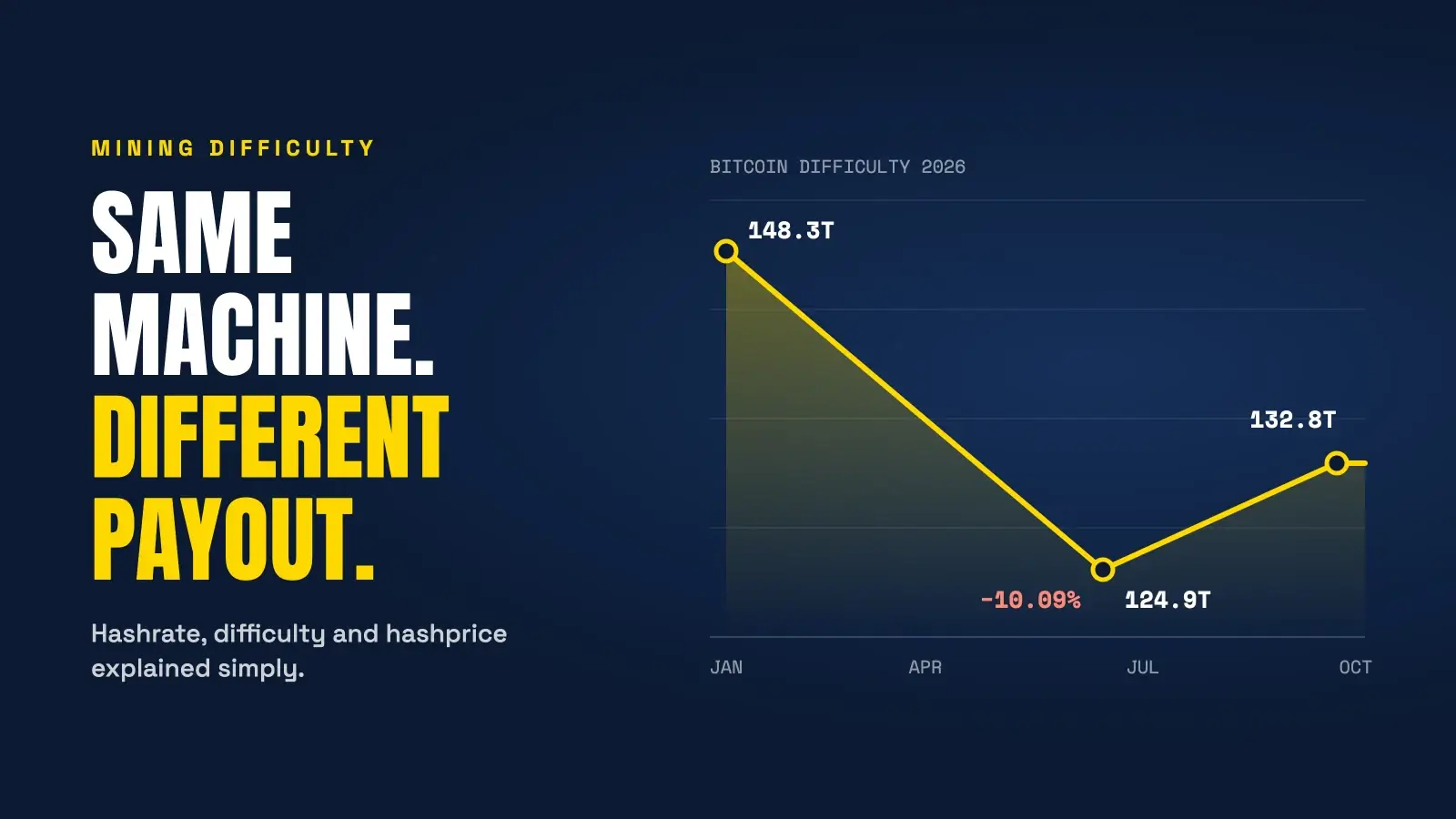
Your machine runs at exactly the same speed it did last month, on the same electricity, connected to the same pool — and it earns a different amount. Two numbers explain almost all of that movement: your share of the network's hashrate, and the network's mining difficulty. They sound technical, but the logic fits in a paragraph, and once you see it you can predict roughly where your earnings are heading instead of being surprised by them. 2026 has been an unusually good year to learn this: Bitcoin difficulty fell ten times, including one of the largest drops in its history, and the next adjustment is due within a day of this article being written.
What hashrate is
Hashrate is simply guesses per second. A miner repeatedly hashes a block candidate with a changing number, looking for a result below the network's target — the guessing race our explainer on how mining works describes in detail. Each guess is one hash, and the units scale in thousands:
| Unit | Hashes per second | Where you'll see it |
|---|---|---|
| kH/s (kilo) | 1,000 | Monero ASICs (X9: 1,000 kH/s) |
| GH/s (giga) | 1,000,000,000 | Scrypt machines (L9: 16 GH/s) |
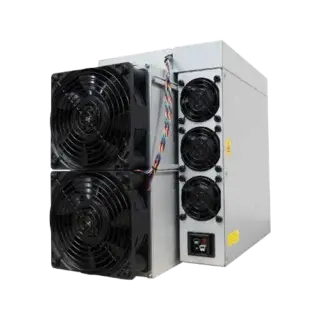
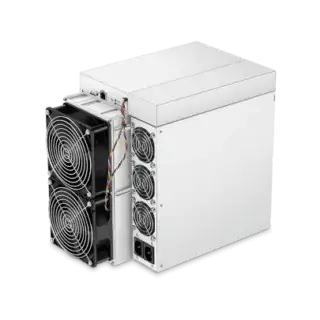
| TH/s (tera) | 1012 | Bitcoin machines (S21 XP: 270 TH/s) |
| EH/s (exa) | 1018 | Whole Bitcoin network (~934 EH/s) |
| ZH/s (zetta) | 1021 | A milestone Bitcoin is approaching |
One trap worth knowing: hashrates across different algorithms can't be compared. A Zcash machine measured in kSol/s and a Bitcoin machine measured in TH/s are doing entirely different work. 840 kSol/s isn't "less" than 270 TH/s — they're different units for different puzzles, and only revenue in euros is comparable between them.
Your hashrate only matters as a share
Here's the key insight. What you earn depends not on your hashrate alone but on your hashrate divided by everyone else's. The formula for expected daily earnings is:
For a 270 TH/s Antminer S21 XP on a ~934 EH/s Bitcoin network, that's a share of about 0.00003%, multiplied by 144 blocks and 3.125 BTC — roughly 0.00013 BTC per day. Double the network's hashrate and your share halves, even though your machine hasn't changed at all. That is the entire reason payouts drift.
What mining difficulty is, and why it exists
Mining difficulty is the network's thermostat. Every blockchain targets a fixed block time — ten minutes for Bitcoin — because that steady pace controls how quickly new coins enter circulation. If miners join and blocks start arriving faster, the network raises difficulty so guessing gets harder. If miners leave and blocks slow down, it lowers difficulty so the pace recovers.
The practical result is that issuance stays on schedule no matter how much hardware joins or leaves. Even if all the world's computers mined Bitcoin, difficulty would rise until blocks still arrived roughly every ten minutes. Different coins retarget at very different speeds:
| Coin | How often difficulty adjusts |
|---|---|
| Bitcoin | Every 2,016 blocks — about two weeks |
| Litecoin | Every 2,016 blocks — about 3.5 days at 2.5-minute blocks |
| Zcash, Dogecoin, Monero | Continuously — every block, using a rolling average |
Bitcoin's slow two-week rhythm is why its difficulty changes arrive as visible, newsworthy jumps. You can watch the current epoch and the next estimated adjustment on CoinWarz's live difficulty chart.
The loop that moves your earnings
Difficulty doesn't respond to price directly. It responds to hashrate, which responds to profit, which responds to price — a loop with a built-in delay:
- The coin price rises, so mining becomes more profitable.
- Miners switch on idle machines and order new ones.
- Network hashrate rises, and blocks come faster.
- Difficulty adjusts upward, shrinking every miner's share.
- Revenue per machine falls back — often while the price is still high.
We measured this happening live. During Zcash's September rally, a Z15 Pro earned $727.30 of revenue per MWh on 24 August and only $708 per MWh on 4 September — about 3% less, even though ZEC had risen sharply in between. That's step five arriving while step one was still in progress, as our Z15 Pro review documents. Monero shows the opposite case: its hashrate rose only about 0.5% over thirty days in September, which told us the feared wave of new ASICs hadn't actually arrived yet.
Why a difficulty drop is good news for miners who stay
This is the counterintuitive part. Headlines about falling difficulty usually sound like bad news for mining — and for the miners who switched off, it was. For everyone still running, it's a pay rise.
On 14 June 2026, Bitcoin difficulty fell 10.09% to 124.93 trillion, the eleventh-largest drop in the network's history, after unprofitable machines went dark and the epoch stretched to 15.6 days. The remaining miners suddenly held a larger share of every block, and hashprice — revenue per unit of hashrate — rose about 13% almost overnight. Difficulty then climbed back as machines returned, reaching 132.76 trillion by late September. Across 2026 so far there have been ten downward adjustments and eight upward ones: the thermostat working exactly as designed.
Hashprice: the shortcut that combines everything
Tracking price, difficulty, block reward and fees separately is tedious, so miners use one number that folds them together: hashprice, the expected revenue per unit of hashrate per day. For Bitcoin it's quoted in dollars per PH/s per day, and in early September it stood around $39.63.
Example: an S21 XP at 270 TH/s × $39.63 ÷ 1,000 ≈ $10.70 per day, before electricity.
When hashprice rises, either the coin got more valuable or difficulty fell. When it drops, the reverse. It's the fastest way to sanity-check any profitability figure a seller shows you.
How to use this when buying a miner
- Assume difficulty rises. Over a machine's lifetime the long-run direction is upward, as more efficient hardware joins. That's why we model purchases at half of today's revenue — the gap covers difficulty growth and price risk together.
- Efficiency is your defence. When difficulty rises, the least efficient machines fall below break-even first and switch off — which then eases difficulty for everyone else. Being among the survivors is mostly a question of J/TH and electricity price.
- Watch the adjustment estimator. If blocks are running fast within an epoch, an upward adjustment is coming; if slow, a downward one. It's the closest thing to a short-term forecast mining offers.
- Don't confuse luck with difficulty. Week-to-week swings at your pool are often just pool luck, which averages out over time — our pool guide explains the difference. Difficulty is the slower, structural force.
- Remember price leverage. When margins are thin, a price rise can outrun difficulty for months, which is the opportunity our Antminer L9 review models — including the scenario where difficulty catches up.
Halvings are the other structural force, cutting block rewards roughly every four years; our halving explainer covers how they interact with difficulty.
FAQ: mining difficulty and hashrate
What is mining difficulty in simple terms?
Why do my mining payouts go down when my machine hasn't changed?
How often does Bitcoin mining difficulty change?
Is a drop in mining difficulty good or bad?
What is hashprice?
Can I compare hashrate between different coins?
Buy machines that survive the next difficulty rise
Difficulty rewards efficient machines on cheap power and squeezes everything else. We've sold miners across Europe since 2015, and we'll model any machine at half of today's revenue so you see the realistic case, not the brochure one. Check the economics in our profitability guide, run machines at industrial rates in our hosting datacentre, or browse current miners.
Disclaimer: We are not financial advisors. Difficulty, hashrate and hashprice figures are a snapshot for 2 October 2026 and change continuously; worked examples use early-September hashprice. Mining revenue depends on coin prices, network difficulty and your electricity costs. Never invest money you cannot afford to lose.
Written by Denis
Best offers
Join Risk Free
30 days refund
100% Safe
Secure Shopping
24x7 Support
Online 24 hours
Best Offers
Grab Now
Free Shipping
On all order over
Know Us
- Top SK-CZ vendor since 2015, now expanding across EU
- Buy directly from our EU wholesalers
- 29 wholesalers = always lowest ASIC prices
- Up to 2-year warranty on Bitmain miners
- Personal support: miner choice, profit calculation
- Free miner setup