Popular
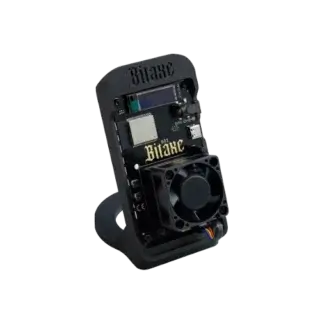
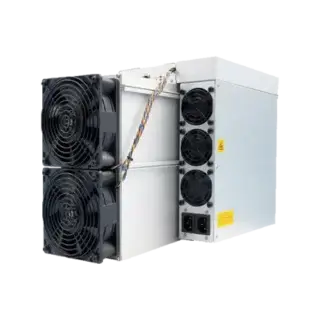
Product Showcase


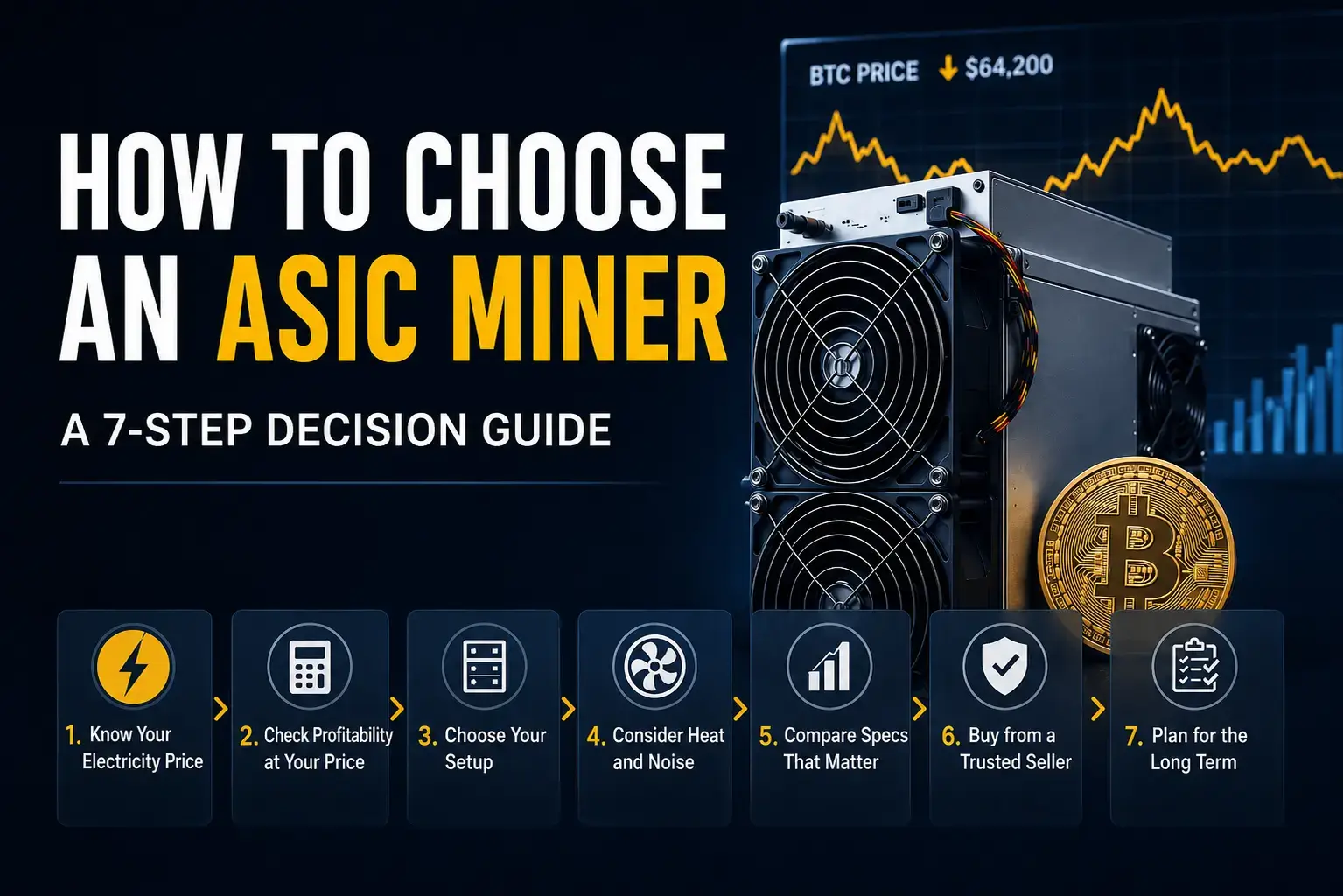
Nearly every guide on how to choose an ASIC miner opens the same way: compare hashrate, then efficiency in J/TH, then cooling. That order is backwards, and it’s why beginners buy machines they can’t run. Specs belong at step five. Step one is your electricity price — because at €0.25/kWh it rules out almost every Bitcoin machine on the market before you read a single spec sheet. With Bitcoin around $64,200 and the Fear & Greed Index at 25, margins are thin enough that this order genuinely decides whether you profit. So here is the sequence we’ve used with European buyers since 2015 — seven steps, in the order that actually matters, with an honest ending: sometimes the right answer is “not yet”.
Step 1: Start with your electricity price, not the spec sheet
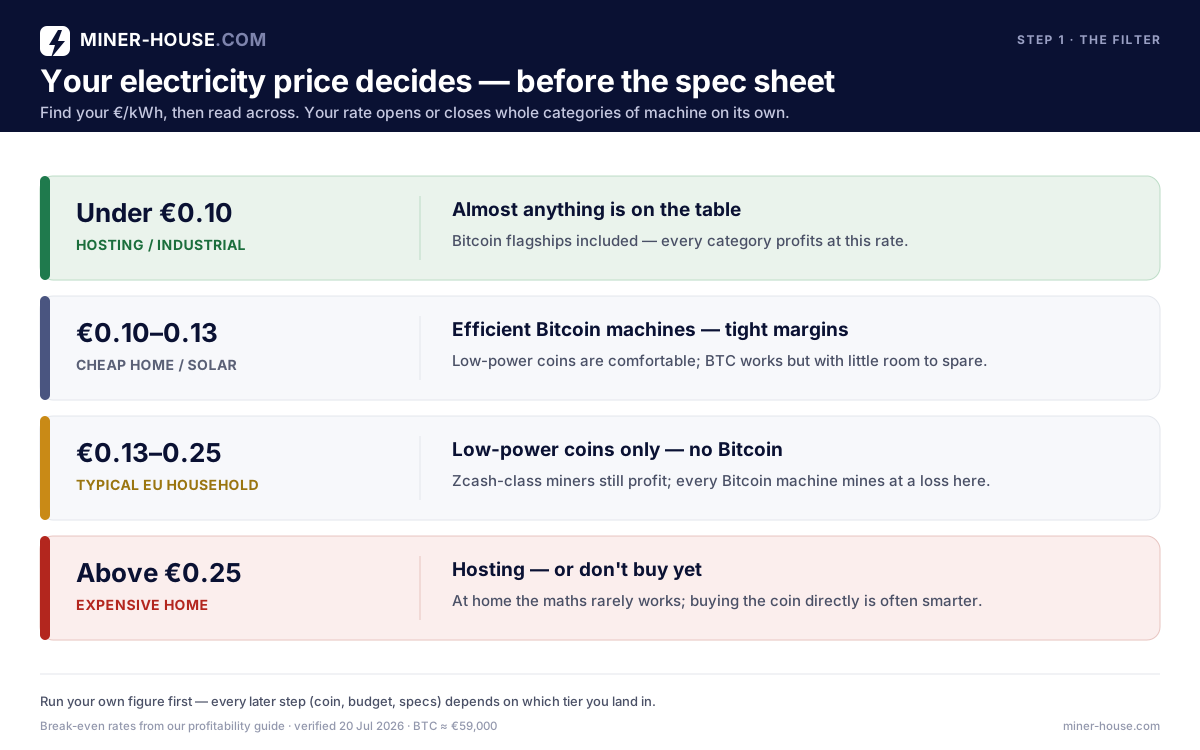
Find your exact €/kWh on your last bill — the full rate including distribution and taxes, not the headline tariff. Then compare it against each machine’s break-even electricity price, the rate at which that model stops earning. This single number eliminates most of the market instantly:
| Your electricity price | What’s realistically open to you |
|---|---|
| Under €0.10/kWh | Almost anything, including Bitcoin flagships |
| €0.10–0.13/kWh | Efficient BTC machines, tight margins; low-power coins comfortable |
| €0.13–0.25/kWh | Low-power coin machines only (e.g. Zcash), no Bitcoin |
| Above €0.25/kWh | Hosting — or don’t buy yet |
We break down each model’s break-even rate in our profitability guide. Run your own figure first, because everything below depends on it.
Step 2: Decide where the machine will physically live
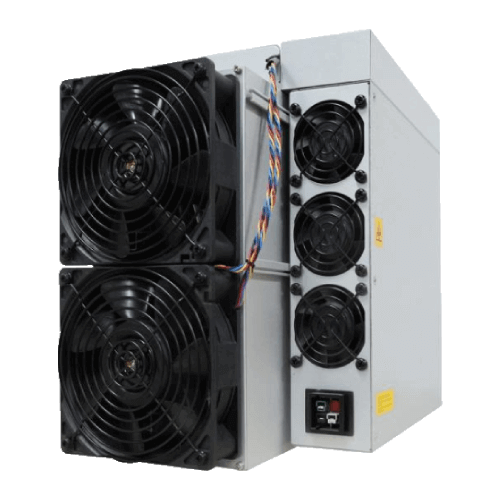
Beginners underestimate this step more than any other. An air-cooled ASIC runs at roughly 75 dB — a vacuum cleaner that never switches off — and dumps about 3.5 kW of heat into the room. It also needs its own dedicated circuit, which typically means €300–1,000 for an electrician even on Europe’s 230 V grid.
So be honest about the location before you shop. A garage, workshop or outbuilding works. A flat, a bedroom or a shared house does not. If you have nowhere suitable, that doesn’t end the plan — it simply moves the machine to a datacentre, which our hosting vs home mining comparison costs out in full.
Step 3: Choose the coin before the machine
This is the step people skip, and it’s the one you can’t undo. An ASIC is single-purpose hardware: a Bitcoin machine mines SHA-256 and nothing else, a Zcash machine mines Equihash and nothing else. Choosing a coin therefore locks in your hardware, and vice versa. Only Proof of Work coins can be mined at all, which our explainer on how mining works covers in detail.
Ask yourself which coin you’d want to hold for two years, since mining is essentially accumulating that coin below market cost. Bitcoin offers the deepest liquidity but the harshest break-even. Lower-power coins tolerate expensive electricity far better. And a machine that mines at a loss today is a bet on the coin’s price recovery — a legitimate strategy, but call it what it is.
Step 4: Set the budget — including the boring second number
Your budget has two parts: the purchase price (typically €1,000–13,000) and the monthly running cost, which most beginners forget. A machine at €0.18/kWh can burn €200–470 of electricity every month, so the second number often exceeds the first within a year.
For payback, use a simple rule: machine price ÷ daily net profit = payback in days. Then apply our honesty test — recalculate it at half of today’s revenue. If the purchase still makes sense at half, it’s an investment. If it only works at today’s peak numbers, it’s a price bet.
Step 5: Now — and only now — compare the specs
With steps 1–4 settled, your shortlist is already short. Here’s what to read on the spec sheet, in priority order:
- Efficiency (J/TH) beats raw hashrate. Efficiency determines your break-even price and therefore your survival in a downturn. The current frontier sits near 9.5 J/TH for Bitcoin machines.
- Power draw in watts — check it against your circuit and your monthly cost from step 4.
- Watch the variants. The same model name often hides different versions: the Antminer KS5 exists as 20 TH/s and 21 TH/s with different consumption, and shops quote them interchangeably. Always confirm the exact variant in writing before paying.
- Cooling type. Air-cooled machines are plug-and-play; hydro models are quieter and more efficient but need plumbing, which rules them out for most homes.
- Verify on a live calculator. Run your shortlist through WhatToMine with your own €/kWh on the day you buy — profitability rankings shift daily.
Our 2026 buyer’s guide lists the current models with these numbers already compared.
Step 6: New or used?
New machines carry warranty — up to two years on Bitmain models through us, against an industry standard of six months — plus current-generation efficiency and predictable resale value. Used machines cost less upfront and can work well if your electricity is genuinely cheap, but you inherit zero warranty, unknown fan and board wear, and faster obsolescence. As a rule: buy used only if you can repair it yourself or the discount is steep enough to absorb a failure.
Step 7: Choose the seller as carefully as the machine
The final step protects everything above it. A €10,000 machine bought from a fake shop is a €10,000 loss, and this market carries an unusual number of fraudulent e-shops. Check the seller’s company registration, domain age, off-site reviews and payment terms — our scam checklist walks through the ten red flags. Above all, prefer payment methods with recourse, and pay on delivery where possible.
The three answers this framework can give
Host it. The machine makes sense, but your home doesn’t — expensive power, noise limits, or no dedicated circuit.
Not yet. Expensive electricity, no suitable space, and a budget you can’t afford to have tied up. Buying the coin directly is often the better maths.
Most guides never mention the third answer, because most guides are written to sell you a machine. We’d rather tell you honestly — a customer who buys the wrong miner doesn’t come back.
Who this decision suits — and who it doesn’t
Buying your first ASIC miner makes sense if:
- Your electricity is under ~€0.13/kWh, you have solar surplus, or you’ll use hosting.
- You have a garage, workshop or datacentre slot for the noise and heat.
- You’re comfortable with a 2–3 year horizon and volatile monthly income.
- You want to accumulate a specific coin below market cost.
It doesn’t suit you if:
- You pay €0.20+/kWh and plan to run the machine at home.
- You need predictable monthly returns.
- You’d be spending money you can’t afford to have locked up for years.
FAQ: how to choose an ASIC miner
How do I choose the right ASIC miner as a beginner?
What is the most important spec on an ASIC miner?
Which ASIC miner is best for a beginner in Europe?
How much does it cost to run an ASIC miner per month?
Should I buy a new or used ASIC miner?
Can one ASIC miner mine different cryptocurrencies?
Tell us your electricity price — we’ll tell you honestly what fits
Since 2015 we’ve helped European miners run these seven steps, and we say “not yet” when the numbers say so. Compare current models in the 2026 buyer’s guide, check whether hosting makes your setup work, or browse miners in stock — with up to 2-year warranty and payment on delivery. Send us your €/kWh and we’ll run a free break-even calculation before you commit.
Disclaimer: We are not financial advisors. Mining profitability changes daily with coin prices and network difficulty; every figure above is a snapshot for 20 July 2026 and not a guarantee of future returns. Do your own research and never invest money you cannot afford to lose.