Popular
Product Showcase


Run one efficient Bitcoin miner at a typical European household tariff and it burns roughly €650 of electricity every month. Put the same machine into miner hosting and the bill drops to about €210. That gap — up to €5,300 per year on a single machine — is why most serious European miners no longer mine in their garage. Still, hosting isn’t automatically the right answer. Because we sell both the machines and the hosting, we’ll do what most comparison articles won’t: show the honest total cost of each option, including the hidden costs on both sides, and tell you when home mining genuinely wins.
What miner hosting actually is
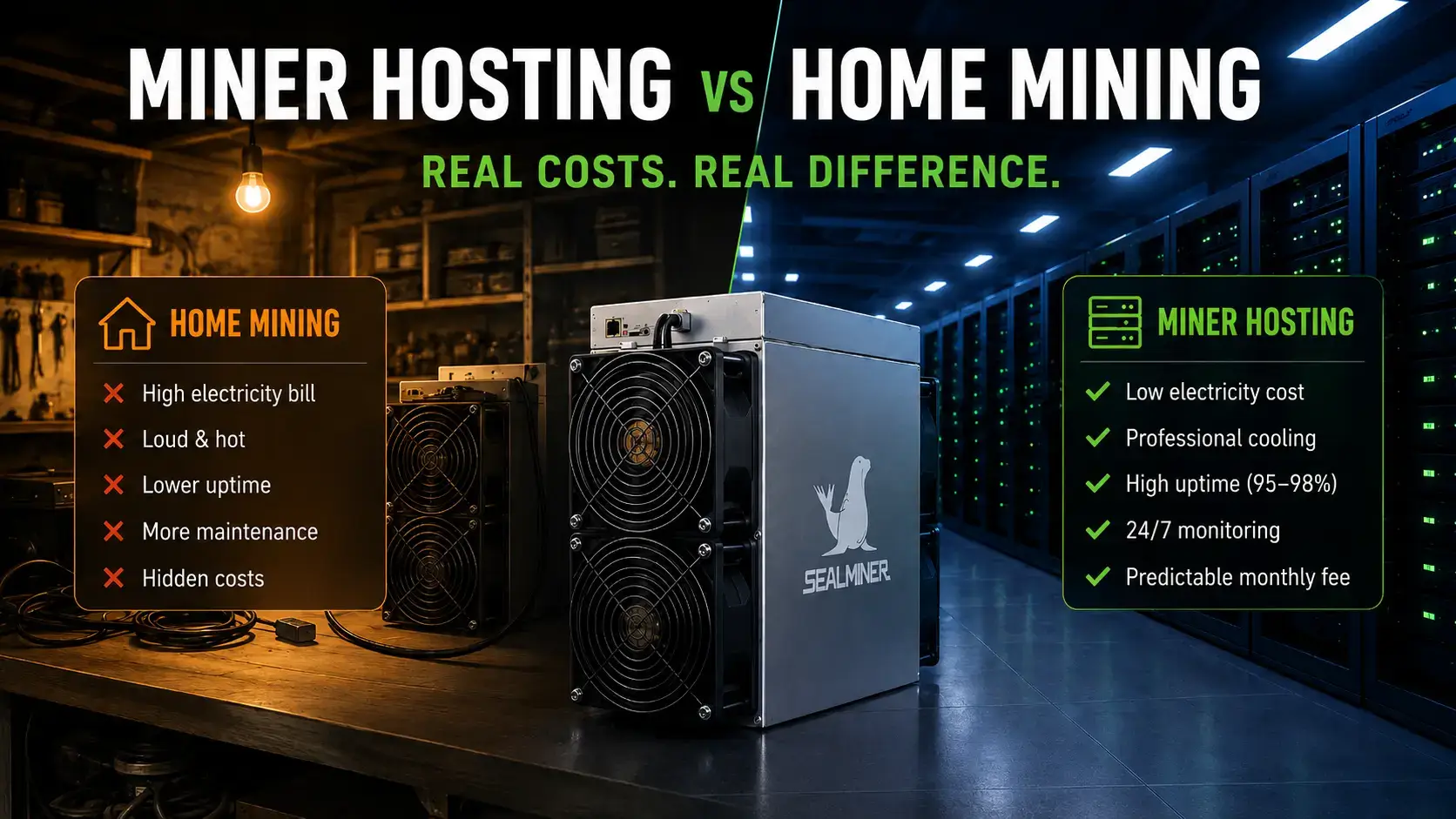
Miner hosting (also called colocation or housing) means you own the machine, but it runs in a professional datacentre. The facility supplies industrial-rate electricity, cooling, monitoring and maintenance, and you pay a monthly fee based on the machine’s consumption. Your miner, your pool, your wallet, your coins — the datacentre only handles the operation. Don’t confuse it with cloud mining, where you own nothing and merely rent promised hashrate; that model has historically attracted scams. With hosting, the hardware remains your asset, and you can have it shipped back to you.
The number that decides it: electricity, side by side
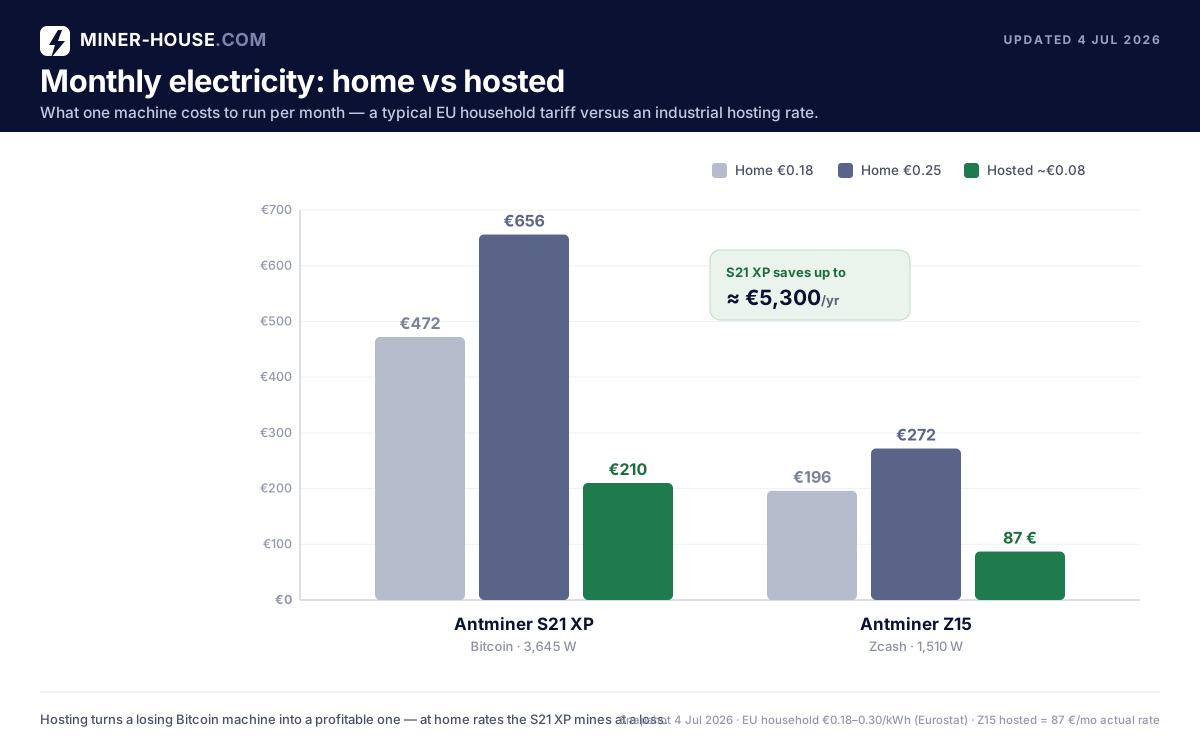
Electricity dominates mining economics, so let’s start there. European household power costs roughly €0.18–€0.30/kWh depending on the country (Eurostat tracks the exact figures). Professional hosting runs on industrial contracts — in our datacentre, for example, a 1,510 W Antminer Z15 costs a flat 87 € per month, which works out to roughly €0.08/kWh. Here is what that difference means per machine, per month:
| Machine (power) | Home €0.18/kWh | Home €0.25/kWh | Hosted ~€0.08/kWh |
|---|---|---|---|
| Antminer S21 XP — BTC (3,645 W) | ≈ €472/month | ≈ €656/month | ≈ €210/month |
| Antminer Z15 — ZEC (1,510 W) | ≈ €196/month | ≈ €272/month | 87 €/month |
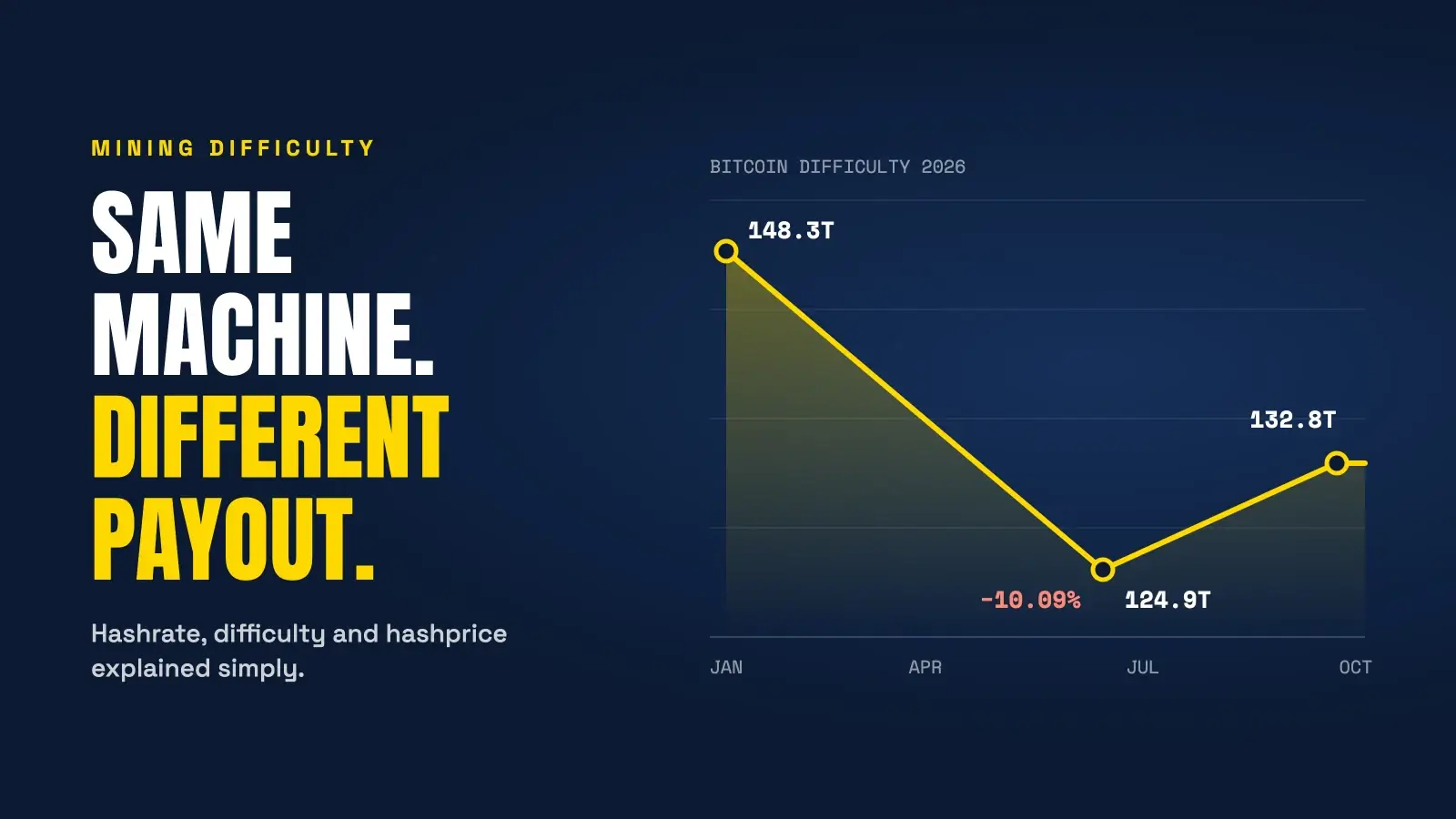
Over a year, hosting saves up to ~€5,300 on the S21 XP and ~€2,200 on the Z15 compared with a €0.25 household tariff. Moreover, for Bitcoin machines this is not just an optimisation — as we showed in our profitability guide, BTC miners currently lose money outright above ~€0.13/kWh. At home rates they bleed; at hosted rates they earn.
The hidden costs of home mining
Electricity is only the visible cost. Home mining carries several costs that never appear in a spreadsheet until they hit you:
- Electrical work. A 3,500 W machine needs its own dedicated circuit. Even on Europe’s 230 V grid (an advantage over the US, to be fair), a proper circuit plus breaker typically costs €300–1,000 with an electrician — more if your panel needs upgrading for several machines.
- Noise. Air-cooled ASICs run at ~75 dB nonstop — a vacuum cleaner that never turns off. In a flat or terraced house, this usually ends the experiment within weeks.
- Heat. An S21-class miner dumps over 12,000 BTU/h (about 3.5 kW of heat) into the room. In summer, you either cool it — paying twice — or throttle it.
- Downtime. Hosted facilities typically hold 95–98% uptime; home setups often manage 80–90% between trips, Wi-Fi drops and overheating. Every offline hour is unearned coin.
- Dust, maintenance and insurance. Fans clog, boards fail, and many household insurance policies take a dim view of industrial hardware running 24/7 in the attic.
The hidden costs of hosting (yes, those exist too)
Now the part hosting providers rarely publish. Hosting has its own friction, and you should price it in before signing anything — with us or anyone else:
- Shipping and transfer downtime. The machine has to travel to the datacentre, and every day in transit earns nothing.
- Contract terms. Some providers lock you into long minimums or charge exit fees. Always check how quickly you can pause, exit or take delivery of your machine.
- Dependence on the provider. Their uptime, their honesty, their electricity contract. A cheap rate from an unreliable host is expensive — this is exactly why we publish a list of fraudulent miner shops.
- Fees can move. Industrial power contracts get renegotiated. Ask how and when your hosting rate can change.
When home mining genuinely wins
Honesty cuts both ways, so here it is: hosting is not always the right call. Home mining wins in three specific situations. First, you have your own cheap power — typically solar with surplus production, effectively mining at near-zero marginal cost. Second, you can use the heat — in winter, a miner is a 100%-efficient electric heater that pays you; heating a workshop with an ASIC flips the economics. Third, you run a compact low-power machine where the absolute cost difference is small and the convenience of full physical control matters more. If none of those apply and you pay €0.15+/kWh, the maths points to hosting.
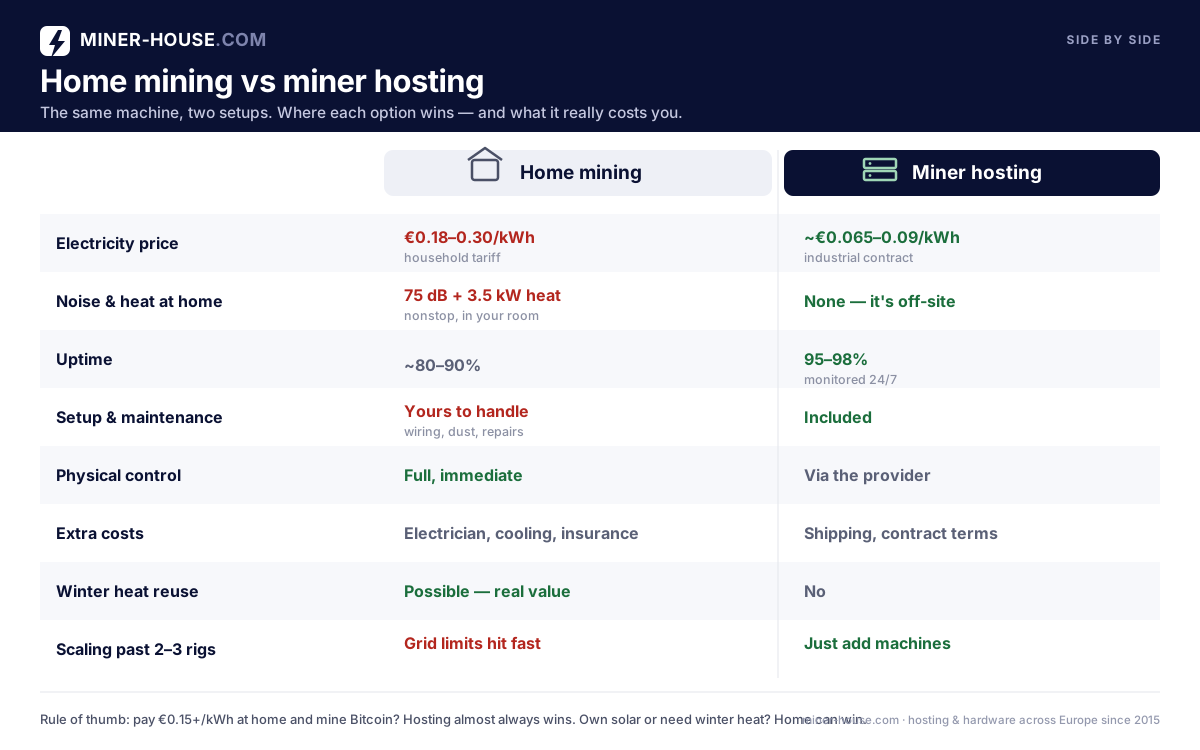
Home vs hosted at a glance
| Home mining | Miner hosting | |
|---|---|---|
| Electricity | €0.18–0.30/kWh | ~€0.065–0.09/kWh |
| Noise & heat at home | 75 dB + 3.5 kW heat | None |
| Uptime | ~80–90% | 95–98%, monitored 24/7 |
| Setup & maintenance | Yours (wiring, dust, repairs) | Included |
| Physical control | Full, immediate | Via provider |
| Extra costs | Electrician, cooling, insurance | Shipping, contract terms |
| Winter heat reuse | Possible — real value | No |
| Scaling beyond 2–3 machines | Grid limits hit fast | Just add machines |
Who should host — and who should stay home
Miner hosting makes sense for you if:
- You pay €0.15+/kWh at home — for Bitcoin machines this is decisive, not optional.
- You live in a flat or family home where 75 dB is unthinkable.
- You want to run more than one or two machines.
- You prefer mining to behave like an investment, not a hobby with cables.
Home mining makes sense for you if:
- You have surplus solar or another source of genuinely cheap power.
- You can reuse the heat in a workshop, garage or greenhouse over winter.
- You value full physical control and accept the noise, wiring and maintenance.
FAQ: miner hosting questions, answered straight
What is miner hosting?
How much does miner hosting cost?
Is miner hosting worth it compared to home mining?
Is miner hosting the same as cloud mining?
What are the risks of miner hosting?
Do I keep ownership of my miner and coins with hosting?
Run your miner at €0.08/kWh instead of €0.25
Since 2015 we’ve hosted machines for European miners in professional datacentres — flat monthly fees, 24/7 monitoring, and honest answers about whether hosting even makes sense for your setup. See our datacentre housing service, pick a machine in the 2026 buyer’s guide, or browse current miners — and message us for a free cost comparison on your exact tariff.
Disclaimer: We are not financial advisors. Mining profitability changes daily with coin prices and network difficulty; every figure above is a snapshot for 4 July 2026 and not a guarantee of future returns. Do your own research and never invest money you cannot afford to lose.