Category
Popular
-
test fan
Price on Request
-
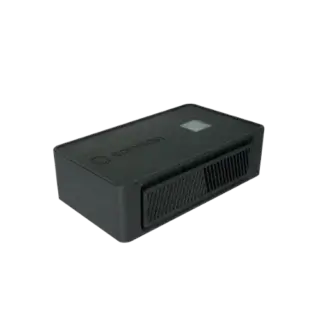
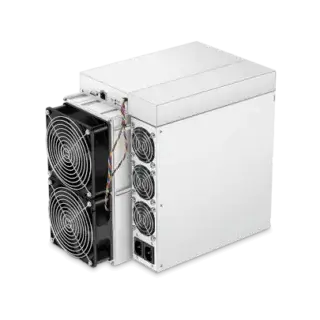
Avalon Nano 3 (4 TH/s)
310€
-
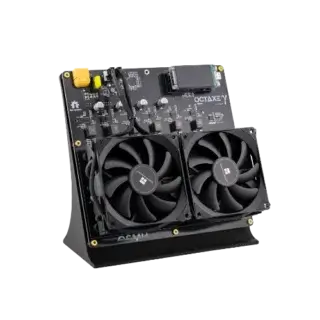
NerdMiner NerdOCTAxe Rev 3.1 (12 TH/s)
480€
-
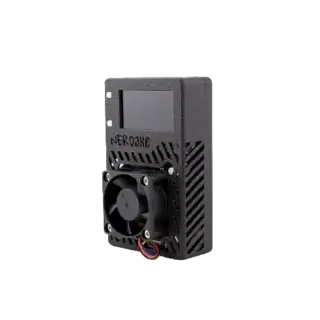
NerdMiner Nerdaxe Ultra (0,5 TH/s)
125€
-
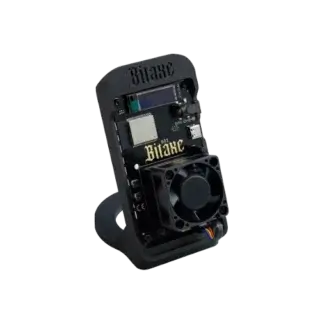
Bitaxe Gamma 601 (1,2 TH/s)
199€
Product Showcase
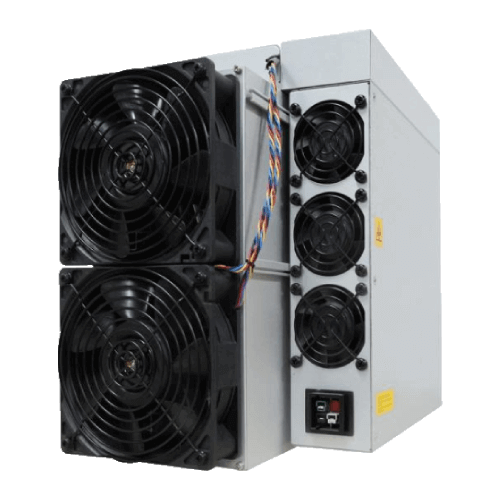
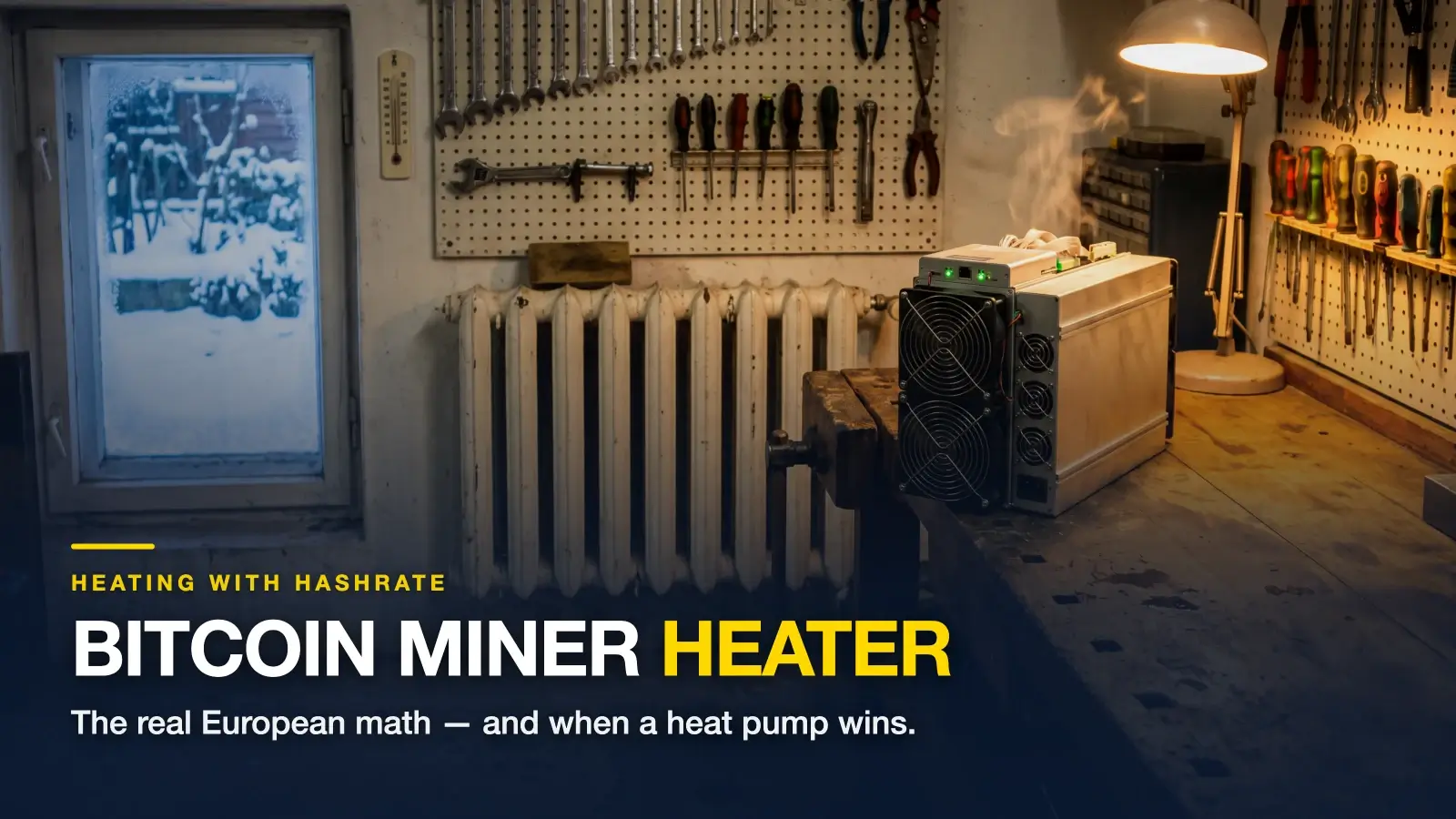
Can a Bitcoin Miner Heat Your Home? The Real European Math
A Bitcoin miner heater sounds like a loophole in physics: the machine converts essentially 100% of the electricity it draws into heat, exactly like an electric radiator, while paying you in Bitcoin for the privilege. That part is completely true. What the American guides dominating this topic skip is the European half of the question — because most homes here don't heat with electric radiators. They heat with gas, or increasingly with a heat pump, and against a heat pump the miner loses by a factor of three or four. So the honest answer isn't yes or no. It's a formula, and this guide gives it to you along with the worked numbers for a European winter.
Why it works: the physics is genuinely on your side
Every watt entering an ASIC leaves it as heat. There's no portion siphoned off into the calculations — computation doesn't consume energy, it just rearranges it, and the chip warms the room at exactly the rate an electric heater of the same wattage would. The conversion is simple: watts × 3.412 = BTU/hr. An Antminer S19 XP drawing 3,010 W therefore produces 10,270 BTU/hr, which is a substantial space heater by any measure.
This is why the framing matters more than the hardware. If you were going to buy that heat anyway, the miner's electricity isn't a cost — it's a heating bill you were already paying, with mining revenue arriving as a rebate on top. That reframe is real, and it's the reason a whole community has grown around it.
The one formula that decides it
Then compare that figure against what your current heating actually costs per kWh of delivered heat. That second number is where most people go wrong, so here it is for the three common European setups at a €0.25/kWh tariff:
| Heat source | Cost per kWh of heat | vs a miner |
|---|---|---|
| Electric radiator / storage heater | €0.25 | Miner wins |
| Gas boiler (~€0.10/kWh gas, 90% efficient) | ≈ €0.11 | Close — depends on the machine |
| Heat pump (COP 3.5) | ≈ €0.07 | Miner loses badly |
A heat pump doesn't create heat, it moves it, delivering three to four kilowatt-hours of warmth per kilowatt-hour of electricity. A miner delivers exactly one. No mining revenue closes a gap that large, so if you already run a heat pump, stop here — mining will not heat your home more cheaply, whatever the marketing says. Against a plain electric radiator, though, the miner wins outright, and against gas it comes down to the machine you choose.
The counterintuitive part: efficient machines make cheaper heat
Here's what nobody in this niche says out loud. Because your heat is fixed at one kilowatt-hour per kilowatt-hour regardless of hardware, the only variable is how much Bitcoin the machine earns while producing it. Consequently an efficient industrial ASIC produces dramatically cheaper heat than a cute desktop miner does.
A modern machine running near 13 J/TH earns roughly twice as much per watt as a hobby-class unit at 35 J/TH. Run both at a €0.25 tariff and the efficient machine can land near €0.11 per kWh of heat — competitive with gas — while the desktop unit sits closer to €0.19, beating only electric radiators. The uncomfortable conclusion follows immediately: the machine that makes the best economic heat is the one you can't put in your living room. It draws 3.5 kW, needs its own circuit, and runs at 75 dB, which our guide to ASIC miner noise explains in detail. Desktop miners aren't a bad idea — they're just a comfort purchase rather than an economic one.
Sizing: match the machine to the room
A reasonably insulated space needs roughly 10 BTU/hr per square foot, which translates into machine wattage neatly:
| Space | Heat needed | Machine class |
|---|---|---|
| Home office, ~30 m² | ≈ 3,000 BTU/hr | ~900 W — small ASIC |
| Drafty basement or garage, ~55 m² | 6,000+ BTU/hr | 1,800 W+ — Antminer L9 class |
| Workshop or outbuilding | 10,000+ BTU/hr | 3,000 W+ — full-size flagship |
Oversizing is a genuine mistake here. A 3.5 kW machine in a 30 m² room turns it into a sauna within an hour, and you'll end up opening windows — which converts your clever heating strategy back into plain expensive mining. Undersize slightly rather than overshoot.
The five things that ruin it
- Summer. The European heating season runs roughly October to April. For the other five months that heat is a liability, and in July you may be paying to cool a room you're paying to heat. Plan what happens in May.
- Noise. A machine large enough to heat properly runs at 75 dB. That's fine in a workshop and impossible in a living room, so the sizing table above collides with reality in most homes.
- You heat one room, not a house. Unless you duct the exhaust into existing ventilation, the warmth stays where the machine is. Whole-home heating means real plumbing or ductwork.
- Dry, dusty air. Miners move enormous volumes of air, which stirs up dust and dries the room. Filters help; expect to clean them.
- Your insurer may disagree. Industrial hardware running unattended 24/7 in a domestic building is worth a phone call before installation, not after an incident.
Who this actually works for
A Bitcoin miner heater makes sense if:
- You currently heat with electric radiators, storage heaters or an electric workshop heater.
- You have a garage, workshop, greenhouse or outbuilding where noise doesn't matter.
- You'd accept modest mining returns in exchange for near-free winter heat.
- You have solar surplus, where the marginal cost of the electricity approaches zero.
It doesn't if:
- You have a heat pump. The maths isn't close, and no machine changes that.
- You have cheap piped gas and only a desktop-class miner to run against it.
- You live in a flat where the only spot is beside a bedroom wall.
- You're expecting the mining income to matter. In this configuration the heat is the product and the coins are the bonus — treating it the other way round leads to disappointment, as our profitability guide sets out.
A realistic way to start
If the idea appeals but you'd rather not commit 3.5 kW to it, start small and deliberately. A compact unit such as the Avalon Nano 3 draws 140 W, costs 310€, runs quietly enough for a desk and doubles as a small heater — enough to learn how mining works, warm a home office corner, and find out whether the noise and the routine suit you before scaling into a garage machine. Just don't expect it to replace your radiators, and check your own tariff against the Eurostat electricity price data before you calculate anything.
FAQ: heating with a Bitcoin miner
Can you really heat a house with a Bitcoin miner?
Is a Bitcoin miner heater cheaper than normal heating?
How much heat does an ASIC miner produce?
What is the best miner to use as a heater?
What do you do with the miner in summer?
Does mining damage the air quality in a room?
Heat that pays you — if your setup fits
We've sold miners across Europe since 2015 and we'll tell you plainly when the numbers don't work, including when a heat pump beats anything we could sell you. Start small with the Avalon Nano 3 at 310€, size a garage machine from our current stock, or check what electricity actually costs where you live in our European price breakdown. Send us your tariff and your heating type, and we'll run the effective heat cost for you before you spend anything.
Disclaimer: We are not financial advisors. Figures above are worked examples for 13 September 2026 at a €0.25/kWh tariff; mining revenue changes daily with coin prices and difficulty, and heating costs vary by country, tariff and building. Check local electrical and building regulations before installing mining hardware in a residential space, and never invest money you cannot afford to lose.
Written by Denis
Best offers
Join Risk Free
30 days refund
100% Safe
Secure Shopping
24x7 Support
Online 24 hours
Best Offers
Grab Now
Free Shipping
On all order over
Know Us
- Top SK-CZ vendor since 2015, now expanding across EU
- Buy directly from our EU wholesalers
- 29 wholesalers = always lowest ASIC prices
- Up to 2-year warranty on Bitmain miners
- Personal support: miner choice, profit calculation
- Free miner setup
Store Updates